
Executive Summary
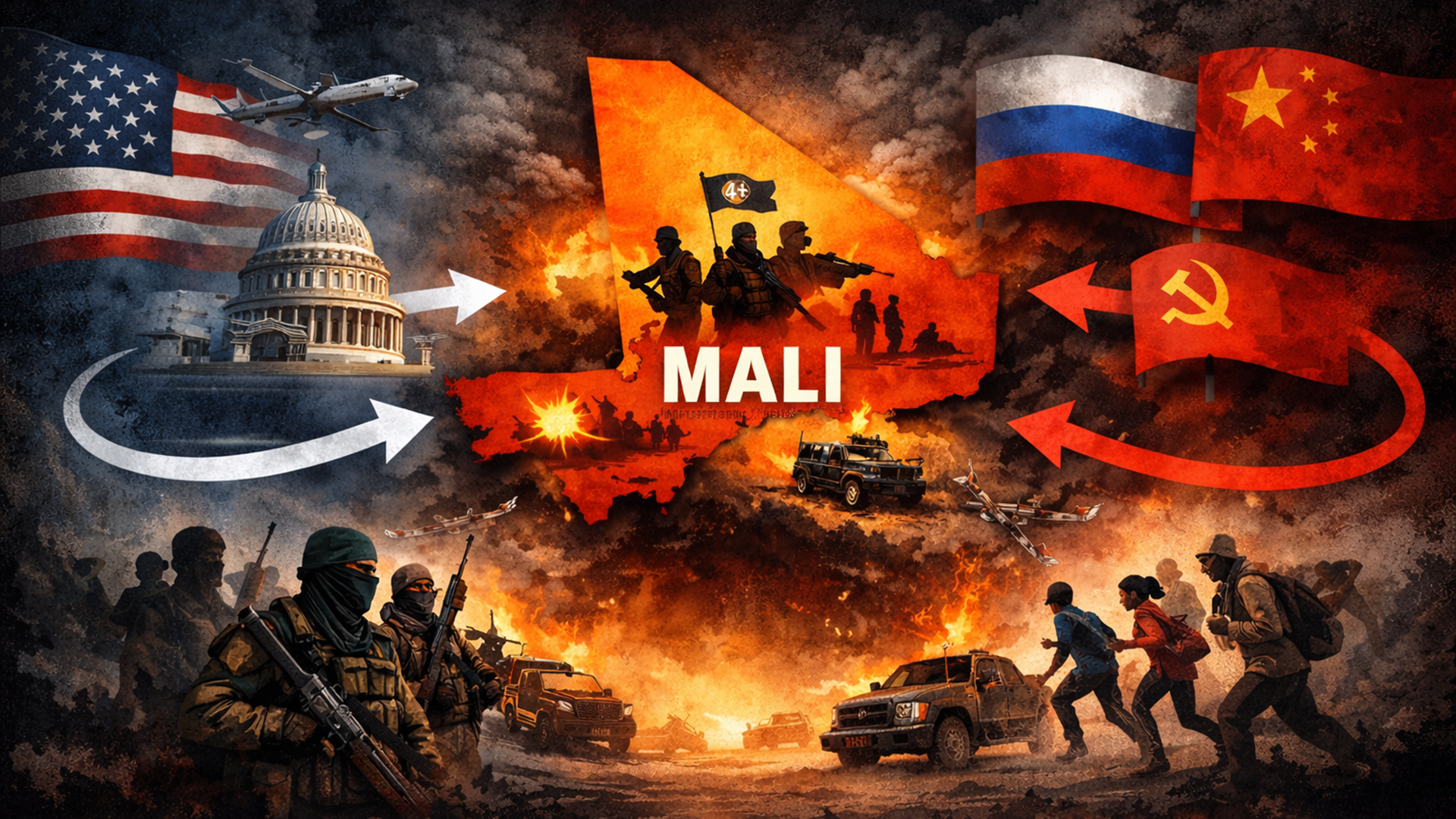
Mali’s security and political crisis continues to deteriorate amid escalating jihadist violence, strained diplomatic relations with France, economic sanctions, and the growing presence of Russian Wagner mercenaries. Civilian casualties are rising, UN peacekeepers remain targeted, and the country’s delayed transition to civilian rule threatens long-term democratic stability.
The convergence of armed insurgency, regional instability, and adversarial power penetration presents strategic challenges for U.S. counterterrorism, governance, and geopolitical interests in the Sahel.
Security Landscape
Since 2012, northern Mali has been contested by jihadist factions, ethnic armed movements, and transnational criminal networks competing for territorial control and trafficking routes. Despite the 2015 Algiers Peace Accord, violence persists among signatory factions.
Jihadist attacks against Malian security forces and UN peacekeepers have intensified, while militants increasingly exploit rural grievances to establish safe havens and recruitment pipelines. The spillover effect destabilizes Niger, Burkina Faso, and northern border regions of Benin and Côte d’Ivoire, reinforcing the Sahel’s transnational security crisis.
The entry of Russian Wagner mercenaries further complicates the security environment, raising documented concerns regarding human rights violations and destabilizing operational conduct.
Implications for U.S. Interests
U.S. interests in Mali and the broader Sahel center on counterterrorism, regional stability, democratic governance, and preventing adversarial geopolitical expansion.
Following Mali’s 2021 coup, the United States suspended security assistance and imposed sanctions and visa restrictions. However, restricted engagement may have accelerated Bamako’s pivot toward Moscow. Wagner’s disinformation strategies pose reputational and strategic risks to U.S. and Western influence in the region.
Strategic Competition: Russia and China
Mali increasingly serves as a testing ground for Russian private military engagement and expanded Chinese security cooperation. In early 2023, Russia and China blocked additional UN Security Council sanctions following Mali’s decision to delay elections until 2026.
Absent calibrated engagement, adversarial powers may deepen security, economic, and political footholds in the Sahel.
Assessment of Current U.S. Policy
U.S. policy emphasizes democratic conditionality and sanctions compliance. Support for ECOWAS-led economic and diplomatic sanctions signals commitment to constitutional order. However, disengagement risks diminishing U.S. leverage amid heightened geopolitical contestation.
Policy Recommendations
1. Counter Adversarial Entrenchment – Develop coordinated diplomatic channels through ECOWAS and the African Union to encourage an expedited transition to civilian rule while preserving conditional engagement.
2. Multilateral Security Coordination – Support AU and ECOWAS security frameworks that complement UN mechanisms and reduce reliance on Russian mercenary support.
3. Strategic Re-Engagement Mechanisms – Explore calibrated security sector reform assistance tied to measurable democratic benchmarks.
4. Information Resilience Strategy – Invest in counter-disinformation programming to mitigate Wagner-style influence campaigns.
Sources
Al Jazeera – “Mali: HRW Condemns ‘Deliberate Slaughter’ of 300 Men by Military.” (April 6, 2022)
https://www.aljazeera.com/news/2022/4/5/mali-military-foreign-fighters-summarily-execute-300-people-hrw
United Nations – “Two UN Peacekeepers Killed in Mali, Four Wounded.” (March 2022)
https://news.un.org/en/story/2022/03/1113442
Deutsche Welle – “Malians Suffer under Strain of Economic Sanctions.” (March 18, 2022)
https://www.dw.com/en/malians-suffer-under-strain-of-economic-sanctions/av-61182123
BBC News – “French Ambassador Expelled from Mali.” (January 31, 2022)
https://www.bbc.com/news/world-africa-60202343
France 24 – “France, Allies Condemn Deployment of Russian Wagner Mercenaries in Mali.” (December 23, 2021)
https://www.france24.com/en/africa/20211223-france-allies-condemn-deployment-of-russian-wagner-mercenaries-in-mali
United Nations – “Economic Sanctions on Mali Tightened.” (Security Council Coverage, 2022)
https://www.un.org/press/en/2022/sc14762.doc.htm
International Crisis Group – Mali Crisis Analysis
https://www.crisisgroup.org/africa/sahel/mali
Voice of America – “Blinken Warns Russian Group Not to Interfere in Mali.” (November 20, 2021)
https://www.voanews.com/a/blinken-warns-russian-group-not-to-interfere-in-mali-/6321400.html
U.S. Congressional Hearing – “The Crisis in Mali: U.S. Interests and the International Response.”
https://www.govinfo.gov/content/pkg/CHRG-113hhrg78949/html/CHRG-113hhrg78949.htm
Foreign Policy Research Institute – “The Wagner Group’s Playbook in Africa: Mali.” (March 25, 2022)
https://www.fpri.org/article/2022/03/the-wagner-groups-playbook-in-africa-mali/
U.S. Department of State – “U.S. Relations with Mali.” (November 24, 2021)
https://www.state.gov/u-s-relations-with-mali/
Institute for Security Studies – “Mali Gives China a Reality Check.” (October 16, 2020)
https://issafrica.org/iss-today/mali-gives-china-a-reality-check
Al Jazeera – “Russia, China Block UN Support for ECOWAS Sanctions on Mali.” (January 12, 2022)
https://www.aljazeera.com/news/2022/1/12/russia-and-china-block-un-support-for-ecowas-sanctions-on-mali
U.S. Department of State – “Mali Sanctions.” (January 11, 2021)
https://www.state.gov/mali-sanctions/
U.S. Department of State – “ECOWAS Action on Mali.” (January 11, 2022)
https://www.state.gov/ecowas-action-on-mali/