
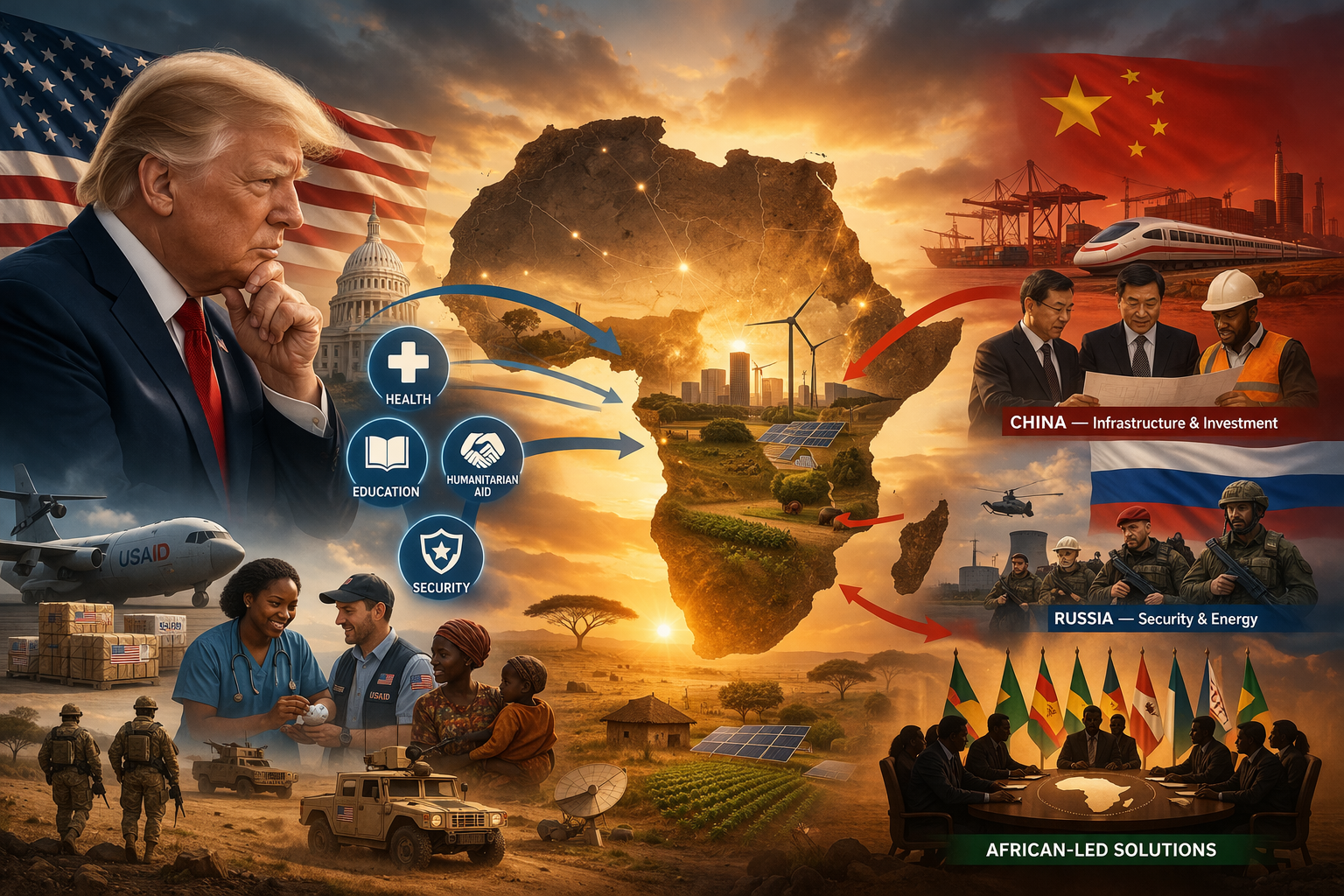
“The dismantling of USAID and the rise of reciprocal bilateral engagements in Africa represent the most significant restructuring of U.S. policy toward the continent since the Cold War.”
A Strategic Inflection Point
The disintegration of USAID marks one of the most consequential inflection points in U.S.–Africa relations in over half a century. For decades, development assistance was not simply a humanitarian channel; it was a structural pillar of American influence on the African continent. It shaped governance incentives, stabilized fragile political environments, reinforced strategic alignments, and embedded U.S. technical and institutional presence inside ministries, public health systems and economic reform programs. Its retrenchment therefore represents more than bureaucratic restructuring. It signals a recalibration of how Washington understands power projection, leverage, fiscal responsibility, and global leadership. Africa, long a theater of strategic competition and diplomatic experimentation, now sits at the center of this recalibration. The question is not whether the United States is disengaging. The deeper question is whether it is redefining the architecture through which it intends to exercise influence.
The Structure of U.S. Foreign Policy
To understand this shift, one must first understand how U.S. foreign policy is made. Contrary to popular perception, American foreign engagement is not driven solely by presidential ambition. It is institutional, layered, and legally constructed. Until recently, the President would articulate strategic direction while Congress authorized and appropriated funding, often attaching conditions that shaped implementation. However, under the Trump 2 administration, elements of foreign assistance recalibration have been advanced through executive action, raising questions about the extent to which congressional oversight has been circumvented or diminished.
Under normal circumstances, the State Department carries diplomatic authority, while the National Security Council coordinates interagency priorities, particularly in matters of security. Foreign assistance, including development and humanitarian programming, has historically operated within this institutional architecture. The Foreign Assistance Act of 1961
formalized USAID as the central development agency, embedding aid within a legislative framework that requires oversight, reporting, and policy coherence. Congress has long exercised influence through funding levels, sanctions regimes, conditionality clauses, and sectoral earmarks. As a result, foreign aid has functioned not merely as an instrument of executive preference, but as a core legislative tool of U.S. foreign policy.
However, recent policy shifts in the Trump 2 administration suggest a growing tension between this traditional institutional framework and the executive branch’s desire for greater flexibility in shaping foreign assistance priorities. The current administration has increasingly relied on program reviews, aid freezes, and bilateral agreements negotiated directly with partner governments to redirect existing funds toward strategic objectives. While these actions often operate within budgets previously appropriated by Congress, they illustrate how the executive branch can significantly reshape the implementation of foreign policy without necessarily seeking new legislative authorizations. This evolving dynamic raises broader questions about the balance of authority between Congress and the presidency in determining how American foreign engagement is carried out.
How the Cold War Shaped U.S. Aid
The origins of USAID lie in strategic necessity rather than benevolence. In his 1949 inaugural address, President Harry Truman introduced the Point Four Program, framing development assistance as a response to the geopolitical realities of the Cold War. Newly independent states across Africa and Asia were not seen as passive development cases but as contested political spaces vulnerable to Soviet ideological influence. Economic development became a containment strategy. By the time Congress enacted the Foreign Assistance Act in 1961, development assistance had been institutionalized as an instrument of strategic stabilization. President John F. Kennedy signed the legislation into law, consolidating U.S. foreign assistance programs under a single civilian development agency.
Across Africa, development programming in agriculture, infrastructure, education, and public health fostered long term relationships that reinforced Western institutional models. Aid built bureaucratic familiarity, professional networks, and diplomatic trust that created leverage. Funding flows could be expanded, redirected, or suspended depending on governance trajectories and security alignment. USAID was not charity. It was soft power structured through legislation.
Post-9/11 Security Integration
Security cooperation expanded under counterterrorism frameworks, particularly in the Sahel and the Horn of Africa. Development aid became intertwined with stabilization policy, governance reform, and counter-extremism initiatives. Security assistance, development programming, and humanitarian engagement were increasingly integrated into a broader architecture of risk management. Washington funded health systems through the President’s Emergency Plan for AIDS Relief (PEPFAR), supported peacekeeping missions through United Nations contributions, and financed capacity building initiatives in ministries of defense and interior. Even leaders resistant to external pressure often calibrated policy positions in response to aid conditionality. The United States remained, until recently, the largest bilateral donor to Sub-Saharan Africa, providing billions annually in development, humanitarian, and security assistance. This financial scale was not simply generosity; it represented embedded influence.
Following the attacks of September 11, 2001, the administration of President George W. Bush elevated Africa’s strategic importance within the broader “Global War on Terror.” U.S. policy increasingly linked development assistance, military cooperation, and intelligence partnerships to counterterrorism objectives. Programs such as the Trans-Sahara Counterterrorism Partnership expanded security cooperation with African militaries as Washington grew concerned about extremist networks operating across fragile regions of the Sahel and the Horn of Africa. These developments culminated in the establishment of the United States Africa Command (AFRICOM) in 2007, a unified combatant command responsible for coordinating U.S. military engagement across the continent. AFRICOM institutionalized Africa’s place within the United States’ global security architecture, integrating defense diplomacy, security sector reform, and counterterrorism cooperation with broader foreign policy objectives.
Alongside this institutional shift, the United States expanded its operational presence across several parts of Africa. American forces maintained a long-standing footprint in Somalia, supporting counterterrorism operations against al-Shabaab and assisting Somali security forces alongside African Union peacekeeping missions. The United States also operated a major drone and surveillance base in Niger, which supported intelligence and counterterrorism operations across the Sahel until recent political changes led to its closure. In East Africa, security cooperation deepened with partners such as Kenya and Djibouti, where Camp Lemonnier serves as the largest permanent U.S. military base on the continent and a critical hub for operations in the Horn of Africa and the Red Sea corridor. These developments further integrated Africa into the United States’ global security strategy, blurring the boundaries between development assistance, diplomatic engagement, and military cooperation.
U.S. Expenditure in Africa: Scale and Strategic Reach
For decades, the United States has been the largest bilateral donor to Sub-Saharan Africa, providing substantial funding across global health, humanitarian response, and security cooperation. According to a 2023 Congressional Research Service report, U.S. assistance to sub-Saharan Africa has generally fluctuated around $8 billion annually, with additional funding provided through humanitarian programs, other federal agencies, and multilateral contributions.
Global Health Assistance
The largest share of U.S. spending in Africa has been directed toward health programs. Through initiatives such as the President’s Emergency Plan for AIDS Relief (PEPFAR) and malaria prevention programs, the United States invested approximately $5–6 billion annually in global health programs across Sub-Saharan Africa by 2023. Since its launch in 2003, PEPFAR alone has invested more than $110 billion globally, with the majority of programs operating in Africa.
Humanitarian Assistance
Humanitarian relief represents another major component of U.S. engagement. According to data from ForeignAssistance.gov, the United States obligated approximately $7.8 billion in humanitarian assistance to Sub-Saharan Africa in FY2022, followed by $5.9 billion in FY2023 and $6.4 billion in FY2024, with annual allocations consistently ranging between roughly $6 billion and $8 billion. Cumulatively, this amounts to over $26 billion in humanitarian assistance between FY2021 and FY2024.
Importantly, the U.S. foreign assistance website lists a portion of U.S. humanitarian assistance delivered through multilateral institutions such as the United Nations High Commissioner for Refugees (UNHCR). UNHCR operations in Sub-Saharan Africa have remained substantial over time, totaling over $2.6 billion between FY2021 and FY2024. Annual contributions ranged from approximately $641 million in FY2021 to $486 million in FY2022, before rising to $713 million in FY2023 and exceeding $840 million in FY2024. This trajectory underscores the central role of UNHCR in implementing U.S. funded refugee protection and displacement response programs across the continent.
Security Assistance
Since the September 11 attacks in 2001, U.S. security cooperation with African states has expanded significantly under counterterrorism and stabilization frameworks. Through programs administered by the U.S. Department of State and Department of Defense, security assistance has included military training, peacekeeping support, counterterrorism cooperation, and security sector reform. According to data from ForeignAssistance.gov, U.S. funding for peace and security programs in Sub-Saharan Africa increased from approximately $128 million in 2001 to $673 million in 2021, fluctuating to $552 million in 2022, rising to $872 million in 2023, and moderating to approximately $604 million in 2024. While annual allocations vary based on regional priorities and appropriations, the overall trajectory reflects a sustained expansion of U.S. security engagement across the continent. This represents a more than fourfold increase compared to pre-9/11 levels.
Despite this growth, security assistance represents a relatively small share of total U.S. engagement in Africa. According to a November 2023 report by the Congressional Research Service, peace and security programs account for approximately 5 percent of total U.S. foreign assistance to the continent.
U.S. Aid Retrenchment in Africa Under Trump’s Second Term
Following the policy shift associated with the second Trump administration and the dismantling of USAID as a central development institution, U.S. engagement in Africa has begun to shift away from large development outlays toward selective strategic engagement.
Preliminary policy signals indicate that overall development and humanitarian spending directed toward Africa is expected to decline significantly, with programs increasingly redirected toward targeted security partnerships, commercial diplomacy and trade initiatives, and critical mineral and supply chain agreements
While final appropriations remain subject to congressional negotiations, analysts estimate that U.S. direct development spending in Africa could decline by several billion dollars annually, particularly in sectors historically administered by USAID.
The long-term trajectory of American financial engagement in Africa therefore remains uncertain. What is clear is that the shift away from development-led engagement represents one of the most significant restructurings of U.S. foreign policy toward the continent in decades.
Redefining U.S. Assistance to Africa Under the Trump 2 Administration
Following the restructuring of U.S. foreign assistance and the dismantling of USAID’s traditional development architecture, Washington has increasingly shifted toward bilateral health cooperation agreements negotiated directly with African governments. These agreements fall under the America First Global Health Strategy, which emphasizes direct government-to-government partnerships, reduced administrative costs, and increased domestic co-financing by partner countries.
At the same time, the new model reflects a broader shift toward reciprocal engagement, in which U.S. assistance is increasingly linked to strategic cooperation from partner states. In several cases, Washington has encouraged participating governments to expand data-sharing on disease surveillance and public health systems, while also exploring wider areas of economic and strategic collaboration. This approach reflects a core principle repeatedly articulated by President Donald Trump that American taxpayer resources should support partnerships that deliver mutual benefits, rather than open-ended development commitments. Several agreements signed since 2025 illustrate this evolving model of engagement.
East African Partnerships
In Uganda, the United States concluded a five-year health cooperation framework valued at approximately $1.7 billion, supporting programs targeting HIV/AIDS, tuberculosis, malaria, maternal and child health, and epidemic preparedness. Uganda also committed to increase domestic health spending by roughly $500 million as part of the agreement.
In Kenya, Washington signed a $1.6 billion bilateral health partnership designed to strengthen infectious-disease surveillance, laboratory systems, and national treatment programs for HIV/AIDS, malaria, and tuberculosis.
In Rwanda, the United States signed a $228 million health cooperation agreement, including $158 million in U.S. assistance to support programs addressing HIV/AIDS, malaria control, and infectious-disease surveillance. The agreement also includes a $70 million domestic financing commitment from the Rwandan government, aimed at strengthening long-term financial sustainability in Rwanda’s health sector.
Central African Partnership
In the Democratic Republic of Congo (DRC), the United States signed a $1.2 billion health partnership agreement covering the period from 2026 to 2031. The agreement includes $900 million in U.S. government funding and $300 million in domestic financing from the Congolese government. The partnership targets major public health priorities including HIV/AIDS, tuberculosis, malaria, maternal and child health, and epidemic preparedness.
Expansion into the Sahel
The bilateral health model has also expanded into West Africa. In Niger, the United States signed a five-year health cooperation agreement valued at approximately $128 million, including $107 million in U.S. assistance and $71 million committed from Niger’s national budget.
In Burkina Faso, Washington concluded a five-year bilateral health cooperation memorandum worth up to $147 million in U.S. funding, with the Burkinabè government committing an additional $107 million in domestic health investment.
In contrast, countries such as Mali illustrate a different trajectory of U.S. engagement. Following the 2020 and 2021 military coups, the United States suspended portions of its security assistance and restricted cooperation in accordance with legal provisions that limit engagement with governments that come to power through unconstitutional means.
Despite the continuation of military rule, recent U.S. efforts to re-establish intelligence, surveillance, and reconnaissance (ISR) operations in Mali signal a notable shift in approach. This evolving posture reflects a growing prioritization of counterterrorism and regional stability concerns over earlier governance-based conditionality. It also highlights an emerging tension within U.S. policy. While congressional frameworks have historically constrained engagement with coup-led governments, the current recalibration appears to be advancing more flexible, executive-driven security arrangements that allow for selective re-engagement in strategically critical contexts.
Aggregate Financial Commitments Under the Trump 2 Framework
When combined, the bilateral health agreements that the United States has signed with Uganda, Kenya, Rwanda, the Democratic Republic of Congo, Niger, and Burkina Faso amount to almost $4.6 billion in direct funding commitments for the health sector.
In addition, African partner governments have pledged over $1.04 billion in domestic health spending, bringing the combined partnership value of these agreements to approximately $5.66 billion.
These agreements illustrate a new model of co-investment, in which both the United States and African governments contribute funding toward shared public health objectives.
A Comparative Analysis Of the U.S. Aid Architecture
The scale and structure of these bilateral agreements differ significantly from the earlier development assistance framework that existed prior to the dismantling of USAID.
Before 2023, the United States was the largest bilateral donor to Sub-Saharan Africa, providing approximately $8 billion annually in core development and humanitarian assistance, according to a 2023 Congressional Research Service report. When broader categories of engagement including global health programs such as PEPFAR, humanitarian response, and security assistance are considered, total U.S. commitments have often been estimated at significantly higher levels. A large share of this funding flowed through USAID-administered programs and major global health initiatives such as PEPFAR, alongside humanitarian relief and security cooperation programs.
Under the new bilateral model, U.S. engagement in Africa is more targeted and sector-specific, with health partnerships forming a central pillar of cooperation. However, the total scale of current commitments approximately $4.6 billion in U.S. funding across multiple agreements remains significantly smaller than the annual development assistance levels previously provided under the broader USAID-led aid architecture.
This shift reflects a broader transformation in U.S.–Africa relations; from large-scale development assistance toward transactional, co-financed partnerships focused on strategic sectors such as global health security.
Domestic Debate and Strategic Recalibration
The recent recalibration under an “America First” philosophy marks a conceptual shift in how foreign aid is understood. Proponents of retrenchment argue that American tax dollars must prioritize domestic infrastructure, economic resilience, border management, and fiscal sustainability. In this view, decades of global engagement produced overstretch, while domestic constituencies experienced stagnation and institutional fatigue. Aid is reframed as discretionary spending rather than strategic investment. Scaling back development assistance is therefore presented as fiscal correction and sovereign discipline. The United States, under this logic, should engage selectively, transact where mutual benefit is clear, and avoid underwriting open-ended commitments. Africa is not excluded from engagement; rather, engagement is recalibrated toward trade, investment, and bilateral negotiation rather than structured development programming.
This recalibration has not unfolded without domestic contestation. Democratic lawmakers, foreign service professionals, humanitarian organizations, and public health advocates argued that foreign assistance constitutes a small percentage of the federal budget while yielding disproportionate diplomatic returns. They warned that abrupt dismantling of institutional capacity weakens American soft power and undermines long-standing partnerships built over decades. Public debate, congressional hearings, and policy advocacy reflected a divided electorate. Some Americans supported retrenchment as fiscal responsibility and strategic realism. Others viewed it as narrowing the country’s global leadership role. The dismantling of USAID therefore revealed not only a foreign policy shift but a domestic philosophical divide over the meaning of American power.
The trade-offs of aid retrenchment are complex. On one hand, reducing development expenditures may provide fiscal flexibility and reinforce demands for reciprocal trade relationships. It may also reduce dependency narratives and compel partner governments to assume greater ownership of reform agendas. On the other hand, the withdrawal of institutional presence reduces day-to-day influence inside African bureaucracies. Development missions historically embedded American technical advisors within ministries, shaping policy formation in subtle but durable ways. Their absence diminishes structured leverage. The erosion of soft power credibility may weaken Washington’s normative authority in governance debates. Moreover, foreign assistance has sustained a domestic ecosystem of development professionals, contractors, and diplomatic personnel whose employment and institutional expertise contribute to broader foreign policy capacity. Retrenchment therefore narrows not only outward engagement but internal capability.
Geopolitical Competition in Africa
Strategic competition intensifies the implications of this shift. China’s infrastructure financing across Africa has expanded through state-backed lending and construction projects. Russia has deepened security partnerships, including through paramilitary support arrangements in parts of the Sahel. Brazil, Russia, India, China, and South Africa (BRICS) expansion provides alternative diplomatic platforms that reduce reliance on Western financial institutions. In West Africa, the Alliance of Sahel States, composed of military-led governments, reflects a political recalibration away from traditional Western conditionality and toward diversified partnerships. Reduced U.S. development engagement does not create neutrality. It creates openings. Where structured influence recedes, transactional actors fill space. The geopolitical environment becomes less hierarchical and more competitive.
The recalibration of U.S. engagement in Africa has unfolded within a broader environment of intensifying geopolitical competition. As Washington reassesses the scale and structure of its development assistance and security partnerships, other external actors, most notably China and Russia have expanded their political, economic, and security footprints across the continent. In many cases, these actors have positioned themselves as alternative partners for governments seeking to diversify their international relationships.
China’s expansion has been driven primarily through infrastructure diplomacy and long-term development financing. Through the Belt and Road Initiative, Chinese state-backed banks and construction companies have financed and built railways, highways, ports, power plants, and telecommunications networks across Africa. Unlike traditional Western aid programs, which often emphasized governance reforms and conditionality, Chinese financing has focused on large-scale infrastructure delivery through concessional loans and turnkey construction projects. For many African governments confronting severe infrastructure deficits, this model offered immediate developmental visibility such as new roads, rail systems, airports, and industrial zones while avoiding the extensive policy conditionality typically associated with Western development assistance.
Russia’s engagement has followed a different trajectory, focusing primarily on security cooperation and military partnerships. Moscow has expanded its presence in several African states through defense agreements, arms sales, military training programs, and security advisory missions. In parts of the Sahel and Central Africa, Russian-linked private military companies, including the Wagner Group, have played an increasingly visible role in supporting governments confronting insurgencies and internal instability.
The political shifts that followed the 2020 and 2021 coups in Mali illustrate how these dynamics have unfolded in practice. After the military takeover in Bamako, the United States and several European partners suspended security assistance and imposed sanctions on Malian leaders in response to the unconstitutional change of government. Confronted with the withdrawal of Western security support while continuing to face an escalating jihadist insurgency, Mali’s transitional authorities sought alternative partners. Russia subsequently expanded military cooperation with the Malian government, while Wagner personnel were deployed to support counterinsurgency operations.
China has also deepened its engagement with Mali and other Sahelian states, particularly through infrastructure projects and economic partnerships. Chinese firms have financed mining operations, transportation infrastructure, and energy projects across the region. In some cases, Chinese military equipment and ammunition have also appeared in Sahelian security inventories, reflecting Beijing’s growing role as a defense supplier to African governments.
These developments reflect a broader pattern of diversification in African foreign policy. Governments across the continent have increasingly adopted a multipolar diplomatic strategy, engaging multiple external partners simultaneously rather than relying primarily on Western donors. The expansion of the BRICS bloc originally composed of Brazil, Russia, India, China, and South Africa has reinforced this trend by providing an alternative diplomatic and financial platform outside traditional Western-led institutions.
Several African states have actively pursued closer engagement with BRICS structures, viewing them as vehicles for expanding access to development finance, trade partnerships, and diplomatic influence. As Western development assistance contracts become more selective, these alternative platforms are becoming increasingly attractive to governments seeking additional economic and political leverage.
Russia’s outreach has also extended beyond the Sahel into Central Africa, where security partnerships have expanded in countries such as the Central African Republic and the Democratic Republic of Congo. These engagements typically combine military advisory support, arms agreements, and political cooperation at the diplomatic level. While the scale of Russian economic investment in Africa remains smaller than that of China or the United States historically, Moscow’s strategy has focused on filling security gaps in fragile states where Western partners have reduced their presence.
The cumulative effect of these dynamics is the emergence of a more competitive geopolitical environment across the African continent. As U.S. development assistance contracts and its engagement model shifts toward more selective bilateral partnerships, other actors have stepped into areas previously dominated by Western institutions. Rather than producing disengagement, the recalibration of U.S. policy has contributed to a redistribution of influence within an increasingly multipolar international system.
For African governments, this evolving landscape provides both opportunity and risk. The presence of multiple external partners can increase bargaining power and expand development options. At the same time, navigating competing geopolitical interests requires careful strategic management to ensure that diversification does not produce new forms of dependency or undermine domestic governance institutions.
African Strategic Repositioning
African governments have responded pragmatically. Many have diversified diplomatic and economic relationships, engaged emerging powers while maintaining ties with Washington. Regional blocs have strengthened coordination mechanisms, and multipolar diplomacy has become a strategic tool rather than a reactive posture. Moreover, this recalibration of U.S. aid accelerates this trend. African states are increasingly negotiating from a framework that balances partners rather than aligns singularly. Data sovereignty, trade conditionality, and security cooperation are now debated within the context of broader global options. The continent is not passive in this transition. It is repositioning within a multipolar order.
The implications of dismantling USAID therefore extend beyond fiscal policy. They alter the architecture through which the United States engages Africa. Development assistance historically enabled Washington to blend humanitarian narrative with geopolitical strategy. Its retrenchment shifts emphasis toward commercial diplomacy and selective security partnerships. Whether this model strengthens American strategic clarity or narrows long-term influence remains uncertain. For Washington, maintaining targeted institutional engagement in strategically critical states will be essential if it seeks to retain leverage without returning to expansive aid frameworks. For African governments, the challenge is to leverage global competition responsibly, ensuring that diversification does not produce fragmentation and that sovereignty remains central to negotiation.
Challenges and Trade-offs of U.S. Aid Recalibration
The recalibration of U.S. assistance to Africa presents a series of structural and strategic trade-offs that may shape the effectiveness of the new engagement model. The shift toward executive-led restructuring raises institutional concerns regarding congressional oversight, potentially affecting the durability and legitimacy of policy direction over time.
At the strategic level, the reduction of long-standing development programs risks diminishing U.S. soft power and day-to-day influence within African governance systems, where embedded technical presence historically reinforced diplomatic leverage. At the same time, declining development engagement creates openings for competing external actors, particularly in infrastructure financing and security partnerships, thereby intensifying geopolitical competition across the continent between the United States, Russia and China.
For African governments, while the transition toward co-financed bilateral partnerships may strengthen ownership and reduce dependency, it also introduces new pressures related to fiscal capacity, policy alignment, and the management of increasingly complex multipolar relationships. The success of this recalibration will therefore depend not only on fiscal efficiency but on whether the United States can sustain strategic influence under a more selective and transactional framework of engagement.
Policy Recommendations: Rebuilding Strategic Balance in U.S.–Africa Relations
For the United States
If the recalibration of U.S. development engagement marks a structural turning point, both Washington and African capitals must respond strategically rather than reactively. The future of U.S.–Africa relations will not be determined by nostalgia for past aid architectures but by the design of new frameworks that reflect geopolitical realities, fiscal constraints, and multipolar competition.
For the United States, the priority should not be a wholesale return to expansive development programming, but a strategic redesign of influence mechanisms. First, Washington must protect core sectors where its credibility remains unmatched particularly in global health, institutional capacity-building, and targeted security sector reform. Programs such as PEPFAR and technical governance partnerships have produced measurable returns in both humanitarian and diplomatic capital. Abrupt disengagement risks reputational erosion that adversarial actors can exploit. Maintaining a lean but focused institutional footprint in strategically critical states will preserve leverage without recreating fiscal overextension.
Second, Congress must reassert its oversight role in recalibrating foreign assistance rather than allowing executive doctrine alone to determine long-term engagement. Aid architecture historically derived its durability from bipartisan legislative foundations. If recalibration is to endure, it must be codified transparently through congressional authorization, funding discipline, and performance metrics that tie assistance directly to measurable governance and security outcomes. Strategic retrenchment should be structured, not improvised.
Third, Washington should shift from a donor-recipient paradigm toward a partnership-based investment framework. Trade facilitation, energy cooperation, digital infrastructure, and mineral supply chain agreements should replace conditional aid as primary engagement tools. However, such agreements must be transparent and mutually beneficial to avoid perceptions of extractive diplomacy. If United States commercial diplomacy expands while development channels contract, credibility will depend on reciprocity and institutional fairness.
For African governments
For African governments, recalibration presents both risk and opportunity. Diversification of partnerships is prudent, but fragmentation weakens bargaining power. Regional coordination through the African Union and sub-regional blocs should be strengthened to negotiate collectively where strategic interests converge. A unified continental voice on trade terms, data governance, mineral partnerships, and security cooperation would prevent transactional asymmetry in bilateral negotiations.
Second, African governments must reduce structural dependency by strengthening domestic revenue mobilization, improving public financial management, and enhancing regulatory stability to attract sustainable private investment. Aid contraction exposes vulnerabilities, but it also creates incentives for internal reform. States that improve governance transparency and policy predictability will be better positioned to leverage multipolar competition without compromising sovereignty.
Third, African policymakers should articulate long-term strategic frameworks to present to Washington rather than reacting to shifting U.S. administrations. Electoral cycles in the United States will continue to produce policy oscillation. Africa’s response should be institutional continuity. Presenting multi-year cooperation roadmaps in security, trade, health, and digital governance would anchor engagement beyond partisan shifts in Washington.
Finally, both sides must recalibrate expectations. The era of development-led alignment is giving way to interest-based negotiation. Strategic clarity requires acknowledging that U.S.–Africa relations are now shaped as much by competition as by cooperation. Institutional mechanisms for regular high-level policy dialogue beyond episodic summits should be formalized to manage friction, clarify interests, and prevent miscalculation.
U.S.–Africa relations are not dissolving. They are being renegotiated. The transition from structured development engagement to more transactional geopolitics signals a new phase in bilateral relations. Africa will continue to matter strategically for security, resources, trade, and multilateral diplomacy. The question is not whether engagement persists. The question is how influence will be structured in an era where development aid no longer serves as the primary instrument of alignment. The next decade will determine whether this recalibration represents disciplined strategic adaptation or a contraction of American global presence. Africa, no longer a peripheral arena, will be central to that determination.
Open to collaboration, advisory engagements, and policy partnerships.
For inquiries: ruth@africathroughwashington.com
Dr. Ruth Esther Namatovu is an independent U.S.–Africa policy analyst and founder of Africa Through Washington (ATW). She specializes in security, governance, international affairs, and strategic engagement.
Well articulated!
Dear Dr. Namatovu,
Your article “Recalibrating U.S. Policy in Africa: Options and Dilemmas Under the Trump Administration” is outstanding—sharp, timely, and refreshingly honest.
You masterfully frame the shift away from traditional aid toward reciprocal, interest-based partnerships not as retreat, but as a bold and necessary recalibration. Your clear-eyed analysis of the opportunities, trade-offs, and early successes (especially the new health partnerships with African governments stepping up) is both pragmatic and empowering.
The piece strikes the perfect balance: intellectually rigorous, geopolitically sophisticated, and genuinely constructive for both U.S. and African policymakers. It should be required reading in Washington and across African capitals.
Thank you for this excellent contribution. Brilliantly done!
Best regards,
John
Thank you, John—I truly appreciate your thoughtful engagement with the article.
I’m glad the analysis resonated, and I look forward to continuing the conversation as U.S.–Africa policy evolves