The U.S. military operation in Nigeria was publicly framed through the language of protecting Christians, executed through counter-ISIS tools, and now sits inside a wider Washington debate over security assistance, religious freedom and U.S. strategic interests. Reuters described the mission as an operation against Islamic State militants, while Trump’s earlier public framing emphasized militants targeting Christians. The result is a policy frame that is morally charged, militarily narrow, and strategically ambiguous.
The United States may have mostly withdrawn its forces from Nigeria, but the policy confusion behind the mission has not withdrawn with them.
On July 3, 2026, the United States pulled back most of its forces from Nigeria following a recent operation against the Islamic State of Iraq and Syria (ISIS), while continuing intelligence support at Abuja’s request. The commander of the United States Africa Command (AFRICOM), Gen. Dagvin Anderson, described the May joint U.S.-Nigerian operation in the Lake Chad Basin as a model for future security cooperation in Africa. But the conclusion of the mission raises more questions than it answers.
The unresolved issue is not only what the United States did in Nigeria, but how Washington defines the mission it conducted. The public record points to several overlapping layers including, a short kinetic combat operation in May, a broader deployment that began with U.S. advisory support in February, and a continuing intelligence partnership that may remain in place without a clear exit strategy. Although most U.S. forces have reportedly withdrawn, Washington has not fully clarified what remains behind, including intelligence support, equipment, advisory mechanisms, or operational commitments.
The congressional oversight question is equally important. AFRICOM’s commander testified before Congress in May, and some lawmakers had already demanded answers on the mission’s legal authority, targeting process, civilian-harm risk, costs, and future U.S. posture. But it remains unclear from the public record whether Congress has been fully briefed on the mission’s conclusion, what was achieved, what remains in place, and how Washington would respond if the Islamic State (ISIS) or Islamic State West Africa Province (ISWAP) resurfaces.
These questions matter because Washington’s Nigeria operation was never explained through one clear policy frame. It was publicly sold through the language of protecting Christians, executed through counter-ISIS military tools, and now sits inside a wider debate over security assistance, religious freedom, U.S. strategic interests, and the Trump administration’s transactional approach to Africa.
That combination makes Nigeria more than a battlefield story. It is a case study in how U.S. foreign policy can move from moral outrage to military action without clearly explaining the doctrine, the exit conditions, or the long-term strategy.
How Nigeria Became the Center of Washington’s Christian-Protection Policy
Before Nigeria became a focal point of the Trump administration’s Christian-protection narrative, it was already one of Washington’s most important partners and practical allies in West Africa. The relationship is anchored in diplomacy, development assistance, humanitarian support, security cooperation, energy interests, and regional strategy. In fiscal year 2024, the United States obligated about $930.2 million in foreign assistance to Nigeria, making it one of the major African recipients of U.S. aid. State Department data also reports partial figures of about $247.2 million for fiscal year 2025. However, most of the fiscal year 2024 assistance was economic and humanitarian rather than military.
Security cooperation has also been part of the relationship. Over the past two decades, the United States has provided more than $232 million in security-sector assistance to Nigeria, alongside major arms sales and defense cooperation. U.S.-Nigeria security ties have included counterterrorism support, military professionalization, maritime and border security cooperation, and major aircraft-related sales designed to strengthen Nigeria’s capacity against armed groups.
Nigeria did not become Washington’s Christian-protection case only because Christians were being killed. Christians have been killed elsewhere. Nigeria became the case because several forces converged: evangelical advocacy, conservative media pressure, congressional attention, Nigeria’s strategic importance, and Trump’s unusual personal proximity to Nigeria through family-linked networks and advisers.
Nigeria came under U.S. scrutiny after Trump threatened military action over the treatment of Christians, while Nigeria argued that the claim misrepresented a complex security crisis. The Washington Post separately reported that Trump’s threat followed pressure from evangelical groups, a Fox News segment, Senator Ted Cruz, and meetings with faith leaders. That suggests the Nigeria issue reached Trump through political and media channels as much as through a formal Africa strategy.
There is also a personal proximity question. Trump has a family connection to Nigeria through his son-in-law, Michael Boulos, whose family has business roots in Nigeria. Michael’s father, Massad Boulos, has been associated with Trump’s advisory network and was later described in reporting as an adviser on Africa and Middle East affairs. That does not prove that family ties caused the intervention. But in Trump’s foreign-policy style, access often matters. Issues can move faster when they are amplified by people, media platforms, or political constituencies close to him.
Nigeria’s elevation as a military priority appears to have been shaped by more than a coherent U.S. Africa strategy. The Christian-persecution narrative had a direct pathway into Trump’s political and personal orbit, giving the crisis domestic political resonance and helping transform a long-standing security concern into an urgent case for U.S. military action.
Religious Freedom or Christian Protection?
The United States has a foreign-policy framework on religious freedom. But that framework is not supposed to be a Christian-protection doctrine. Under the International Religious Freedom Act, U.S. policy is meant to promote freedom of religion or belief abroad, condemn violations, and encourage foreign governments to protect religious liberty. The U.S. Code describes religious freedom as covering theistic and non-theistic beliefs and the right not to profess or practice any religion.
In Nigeria, that distinction carries serious policy consequences. Trump’s framing did not present the crisis primarily as a universal religious-freedom challenge. It recast it as a Christian-protection emergency. Politically, that framing is powerful but strategically, it is risky. If Washington is prepared to use military force under the banner of protecting Christians in Nigeria, it must explain why Nigeria became the test case, why Christian victims became the central trigger, and why comparable religious or communal violence in Mali, Niger, Burkina Faso, Sudan, or even in Uganda’s Muslim community and other African states has not generated the same level of military urgency.
While violence against Christians in Nigeria should not be ignored, Washington’s handling of the crisis appears selective rather than universal. Instead of presenting Nigeria as a broader civilian-protection and religious-freedom crisis affecting multiple communities, the Trump administration elevated Christian victimhood as the central justification for military action. That framing gives the policy strong domestic political appeal, but it also narrows U.S. credibility and raises doubts about whether religious freedom is being applied as a consistent principle or used as a political trigger.
Nigeria’s government has pushed back against the suggestion that it is indifferent to Christian suffering. It insists that its security forces target armed groups that attack both Christians and Muslims, not one religious community alone. AP reporting has also emphasized that Nigeria’s violence is more complex than a single Christian-persecution narrative. While some attacks do target Christians, the country’s insecurity is also shaped by Islamist insurgency, banditry, kidnapping, farmer-herder conflict, communal violence, and weak state presence. These overlapping drivers make Washington’s Christian-protection frame politically powerful, but analytically incomplete.
Understanding the Kinetic Combat Mission
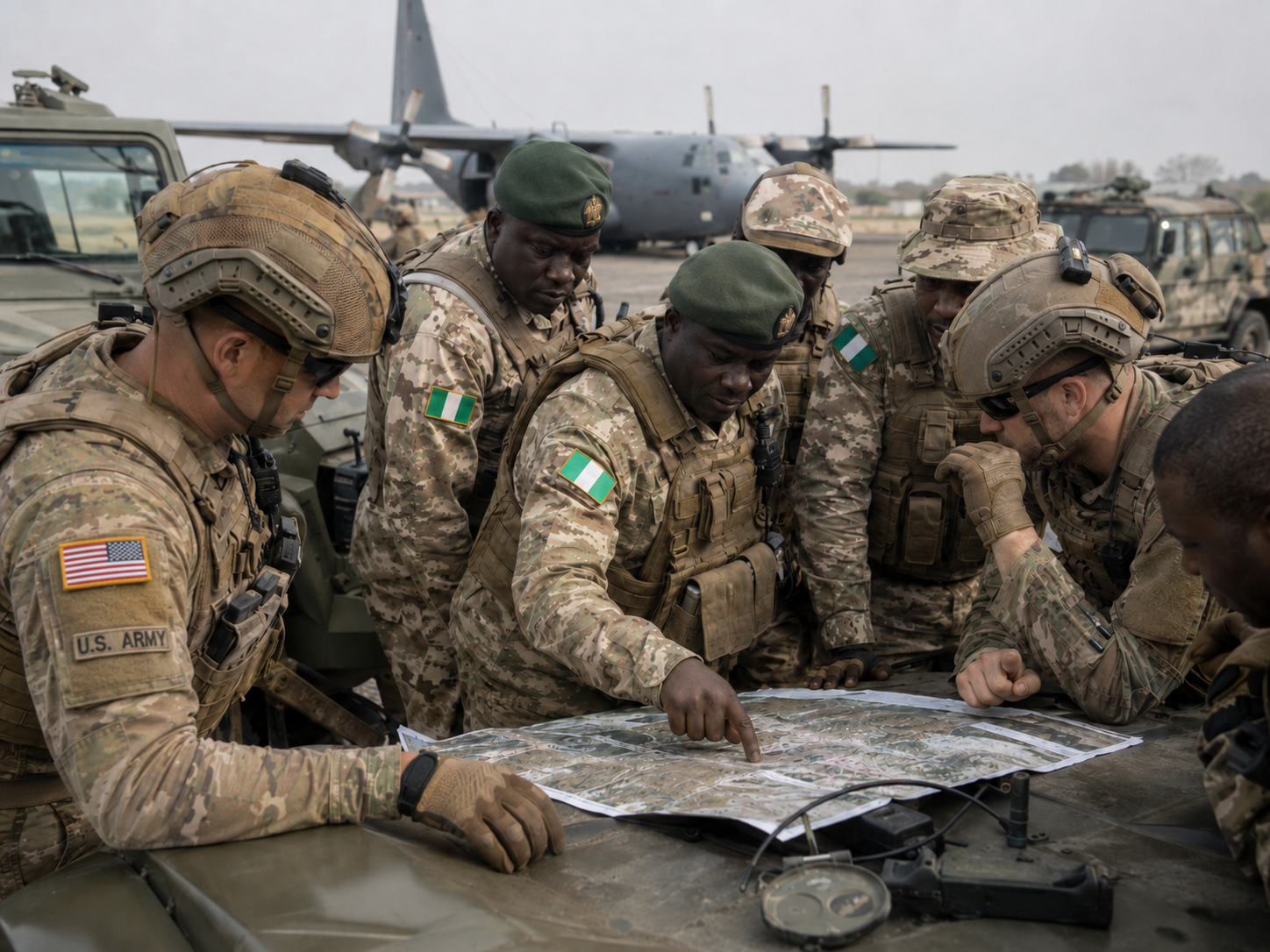
In February 2026, about 100 U.S. military personnel arrived in Nigeria as Washington scaled up an operation against Islamist insurgents. Another 200 U.S. troops were expected to focus on training and advising, not direct combat, while Nigerian forces would retain control over security decisions.
In May 2026, Nigerian forces working with the United States reported that they had killed 175 Islamic State militants in joint air and ground strikes in the northeast. The operation reportedly destroyed checkpoints, weapons caches, logistics hubs, and financing networks used by ISWAP. By July 2026, the United States had withdrawn most of the forces deployed for the operation and was continuing intelligence support at Abuja’s request. That sequence neither portrays a long-term stabilization mission nor a peacebuilding intervention. It was also not a clearly explained doctrine for civilian protection. Instead, it points to a short disruption-focused military operation designed to identify targets, strike leadership and infrastructure, gather intelligence, support Nigerian follow-up operations, and then draw down most U.S. forces.
Killing senior commanders can weaken networks, interrupt planning, disrupt financing, and generate intelligence from phones, laptops, documents, and other materials recovered after operations. But it does not equal victory over terrorism. Armed groups can scatter, go underground, move into neighboring areas, recruit new fighters, and wait for security pressure to ease while they regroup.
Consequences of the U.S. Kinetic Combat Operation
The U.S.-Nigerian operation produced immediate tactical relief. The reported killing of senior ISIS-linked militants and destruction of ISWAP infrastructure likely disrupted command structures, communications, movement, financing, and planning. For Nigerian forces and communities in the area of operation, that may have reduced pressure in the short term. In that narrow military sense, the operation mattered. But degradation is not defeat. Killing senior militants may weaken ISIS or ISWAP for a period, but it does not remove the conditions that allow such groups to regenerate. Those conditions range from weak state presence, porous borders, and arms flows to illicit financing, recruitment networks, local grievances, and insecurity across the Lake Chad Basin. Once U.S. forces leave or reduce their role, the real test is whether Nigerian forces can sustain pressure without waiting for another U.S. intervention.
The operation may also create a retaliation risk against U.S. personnel, infrastructure, allies, and interests. ISIS-linked groups often treat leadership losses as a reason to prove they remain capable, and a U.S. supported strike gives them a clear propaganda target. Retaliation may not come immediately, but it could emerge through attacks on U.S. linked projects and the Nigerian government itself. In that sense, the mission may have reduced one threat in the short term while creating a wider security burden for both Abuja and Washington.
There is also a displacement and stabilization problem. Heavy fighting, air operations, or fear of militant retaliation can push civilians away from already fragile communities. Even when militants are removed, people may not return unless they trust that security will hold. If homes, markets, farms, schools, or livelihoods were disrupted, Nigeria may face pressure to provide resettlement, reconstruction, food assistance, and protection. If U.S. support helped produce the military outcome, Washington may also face questions about whether it has any responsibility to support stabilization after the strike.
The civilian-harm dilemma makes this more sensitive. Nigeria’s own air operations have faced allegations of civilian casualties, which authorities have often disputed. In such an environment, deeper U.S. intelligence or operational support cannot be treated as risk-free. If civilians are harmed, displaced, or pushed into greater insecurity, local communities may blame not only Abuja but also Washington. That could weaken public trust, feed anti-American narratives, and make future security cooperation politically costly.
The Christian-protection framing may also trigger new community tensions. In a country where violence overlaps with religion, ethnicity, land, criminality, and weak state authority, a U.S. “save Christians” narrative can easily be interpreted as taking sides in Nigeria’s internal religious landscape. Christian communities may feel seen and protected, but Muslim communities and other groups may ask why their own victims are less visible in Washington’s language. That perception can create resentment and suspicion that neither Abuja nor Washington may easily contain. The danger is that Washington may kill militants in the name of protecting Christians but leave Nigeria with a deeper intercommunal problem that military force cannot solve.
Another consequence is the risk of a security dependency trap. If the United States intervenes, kills ISIS-linked leaders, withdraws most of its forces and assets, and leaves Nigeria to wait for the next crisis, Abuja may begin to treat the U.S. kinetic intervention as a fallback option each time ISWAP resurfaces. This could reduce the incentive to build Nigeria’s own sustained counterterrorism capacity in intelligence collection, rapid response, air-ground coordination, border control, local policing, civilian protection, and long-term stabilization. Instead of developing the military tactics and operational strength needed to contain insurgents independently, Nigeria could drift into a cycle where the first strategic question becomes how to bring Washington back into action. That may offer temporary relief, but it does not produce national security resilience.
The deeper consequence is strategic uncertainty. Washington has not clarified what happens if ISWAP resurfaces. It has not said whether cross-border regrouping would trigger future U.S. strikes. It has also not explained how continued attacks against Christians would be judged after the operation. Without a clear long-term strategy, the mission risks becoming a hit-and-leave model. It may look tactically impressive and politically dramatic, but it remains strategically unfinished.
The Transactional Question: Security Assistance Beyond Religion
The Trump administration has openly shifted Africa policy toward trade, commercial diplomacy, and reciprocal benefit. Reuters reported that U.S. envoys in Africa would be judged more by commercial deals than by aid spending, with emphasis on trade, infrastructure, minerals, and competition with China and Russia. Under that worldview, security assistance to an African country is unlikely to be treated as charity.
Nigeria is not strategically marginal. Nigeria remained the top African crude supplier to the United States in 2025, supplying 46.618 million barrels and accounting for 52.2 percent of Africa’s crude exports to the U.S. The U.S. government’s own commercial guide identifies significant opportunities in Nigeria’s liquefied natural gas (LNG), oil services, infrastructure, and solid minerals such as lithium, gold, and zinc.
That does not prove that oil drove the military operation. But it does place the operation in a country where security, energy, commercial access, mining, regional influence, and U.S.-China competition overlap. Religious freedom and counterterrorism may be the public language of the mission, but the wider relationship is more transactional. It includes security cooperation, energy interests, market access, commercial diplomacy, and regional influence.
U.S. Policy Dilemmas and Opportunities
The central dilemma is moral selectivity. A policy framed around protecting Christians may highlight real persecution, but it can also narrow Washington’s attention in a country where violence crosses religious lines. Muslims, traditional believers, schoolchildren, farmers, displaced people, and other civilians have also been killed by armed groups, criminal networks, communal violence, and state security failures. A credible religious-freedom policy must protect Christians without making other victims invisible.
The mission also carries strategic ambiguity. The Pentagon may describe it as counterterrorism. Trump may present it as Christian protection. Congress may approach it through religious freedom and security-assistance conditions. AFRICOM may frame it as a model for partner-led operations in Africa. These frames can overlap, but they do not amount to the same policy.
There is also a sovereignty risk. Nigeria accepted U.S. support and requested continued intelligence cooperation. But when Washington publicly threatens military action and conditions assistance, partnership can begin to look like pressure. That pressure may be useful if it pushes Abuja to protect civilians, investigate abuses, and improve accountability. It may become dangerous if Nigerian leaders use it to dismiss legitimate concerns as foreign interference.
The opportunity lies in how Washington uses its leverage. U.S. support could strengthen civilian protection, transparent targeting, civilian-harm investigations, safe return for displaced communities, and stronger accountability. But if security assistance becomes a back door for opaque resource or commercial bargains, the Christian-protection narrative will look less like moral concern and more like strategic cover.
Policy Recommendations
1. Reframe U.S. policy around universal religious freedom, not Christian protection alone.
The United States should not position itself as the defender of Christians in Nigeria alone. If Washington is acting under the principle of religious freedom, then its policy must protect all religious communities facing violence and persecution. Christians should be protected, but so should Muslims, traditional believers, displaced communities, schoolchildren, farmers, and other civilians affected by extremist violence, communal conflict, criminal networks, and state security failures. A credible U.S. religious-freedom policy must be universal, not denominational.
2. Separate civilian protection from resource driven security bargains.
U.S. intervention in Nigeria should not be tied, openly or indirectly, to access to oil, minerals, markets, or other natural resources. The Trump administration’s Africa policy already emphasizes trade, commercial diplomacy, minerals, and reciprocal benefit. That makes transparency essential. If security assistance appears connected to resource access, Washington risks turning a religious-freedom claim into a resource-security bargain. In Africa, that would be read not as partnership, but as a new form of strategic extraction that carries echoes of colonial-era resource politics.
3. Establish a clear evidence threshold before future religious freedom interventions.
If the United States wants to act in defense of Christians or any other religious community abroad, it should not do so through public threats, political pressure, or unclear claims. Washington should first establish a clear evidentiary threshold showing who is being targeted, who is responsible, whether the state is unwilling or unable to protect civilians, and what form of U.S. support is legally and strategically justified. Future U.S. responses should be evidence-based, consultative, and tied to a clearly defined civilian-protection objective rather than a reactive “save Christians” campaign.
4. Establish a sustained joint counterterrorism command and coordination post.
The Nigeria operation may have degraded ISIS linked networks, but it did not defeat them. If ISWAP resurfaces, the threat will return unless Nigeria and its partners maintain pressure beyond the immediate strike. The United States should support a sustained joint counterterrorism command and coordination post with Nigeria, linked where appropriate to AFRICOM, Nigerian security agencies, and Lake Chad Basin partners.
Its role should be to track militant regrouping, improve intelligence sharing, support Nigerian follow-up operations, protect vulnerable communities, and reduce the risk of retaliatory attacks. This should not be framed as an extension of a “save Christians” campaign. Counterterrorism and civilian protection in Nigeria must protect all Nigerians targeted by armed groups, including Christians, Muslims, traditional believers, displaced people, schoolchildren, farmers, and other civilians.
5. Require post-operation accountability and civilian-harm review.
After any U.S.-supported combat operation in Nigeria, Washington should provide a clear account of what was achieved, what support remains, and what risks were created. Congress should be briefed on the mission’s legal basis, the assets used, the intelligence shared, the targets selected, and any continuing U.S. role after most forces withdraw. Any allegations of civilian harm, displacement, or retaliatory violence should also be reviewed. A mission justified in the name of protecting civilians cannot avoid accountability for what happens after the strikes.
Conclusion
The U.S. operation in Nigeria achieved a tactical result, but it did not settle the policy problem behind it. Senior Islamic State-linked militants were reportedly killed, ISWAP networks were disrupted, and intelligence cooperation with Abuja deepened. Those are real gains. They are not the same as strategic clarity.
The deeper issue is the gap between the public justification and the operational reality. Washington framed the crisis through Christian protection, fought it through counter-ISIS tools, and carried it out in a country central to U.S. energy, commercial, mineral, and regional interests. That overlap leaves the mission open to competing interpretations.
The Nigeria operation cannot be judged only by the militants killed. It must also be judged by what remains unclear. The evidence behind the Christian-protection claim, the legal basis for the mission, the level of congressional oversight, the risks created for Nigerian communities, and the broader U.S. interests tied to Nigeria still require scrutiny. Without that clarity, the operation may stand as a tactically successful mission that left Washington’s Nigeria policy strategically unfinished.
For collaboration, advisory work, speaking engagements, or policy partnerships, contact: ruth@africathroughwashington.com