Washington’s decision on UNSOS shows what happens when a foreign policy built around immediate returns confronts a peace operation whose value lies in the crisis it prevents. That uncertainty is already forcing AU troop-contributing countries to search for answers. Their commanders met in Kampala on July 29 to seek alternatives for sustaining the mission after UNSOS’s exit.
The Trump administration has openly shifted U.S. policy in Africa away from what it calls one-way assistance and toward trade, investment and identifiable commercial deals. At the 2025 U.S.-Africa Business Summit, the State Department said that commercial diplomacy would become a priority for every U.S. ambassador on the continent. Success would be measured by “deals delivered, not cables written.”
That approach creates a difficult test for African peace operations. Their returns are rarely immediate or commercial. Their value lies in containing armed groups, preventing territorial collapse and creating the stability in which future governance, trade and investment can take place.
Somalia exposes this tension. Its importance to the United States lies mainly in security rather than immediate commercial opportunity. Washington has an interest in containing al-Shabaab and Islamic State in Somalia (ISIS-Somalia), and in protecting major maritime routes near the Horn of Africa. Yet the insecurity that makes Somalia strategically important also makes large-scale U.S. investment difficult and costly.
There is no public evidence that Washington decided to end support for the United Nations Support Office in Somalia (UNSOS) because Somalia offers too few commercial opportunities. The connection is analytical, not an official explanation. Even so, the decision fits a wider policy that increasingly judges international engagement by immediate leverage, burden-sharing and measurable benefit to the United States.
The decision therefore reaches beyond one UN office. It tests whether African Union peace operations can retain U.S. support when their main return is preventive and long term rather than a visible deal.
The United States’ Financial Leverage over Peace Operations
The United States has unusual influence over this debate because of its financial weight at the United Nations. It is assessed 22 percent of the UN regular budget and 26.95 percent of UN peacekeeping expenses. Against the approved $5.38 billion peacekeeping budget for 2025-2026, that assessment is roughly $1.45 billion.
The Trump administration has used that leverage as part of a broader retreat from multilateral spending. The Rescissions Act of 2025 removed $361.2 million in FY2024 and FY2025 unobligated balances from the account for U.S. contributions to international peacekeeping activities. A later White House package targeted a separate $445 million Peacekeeping Operations account and singled out nearly $300 million annually for Somalia peacekeeping and United Nations (UN) programs as spending that had failed to deliver lasting security.
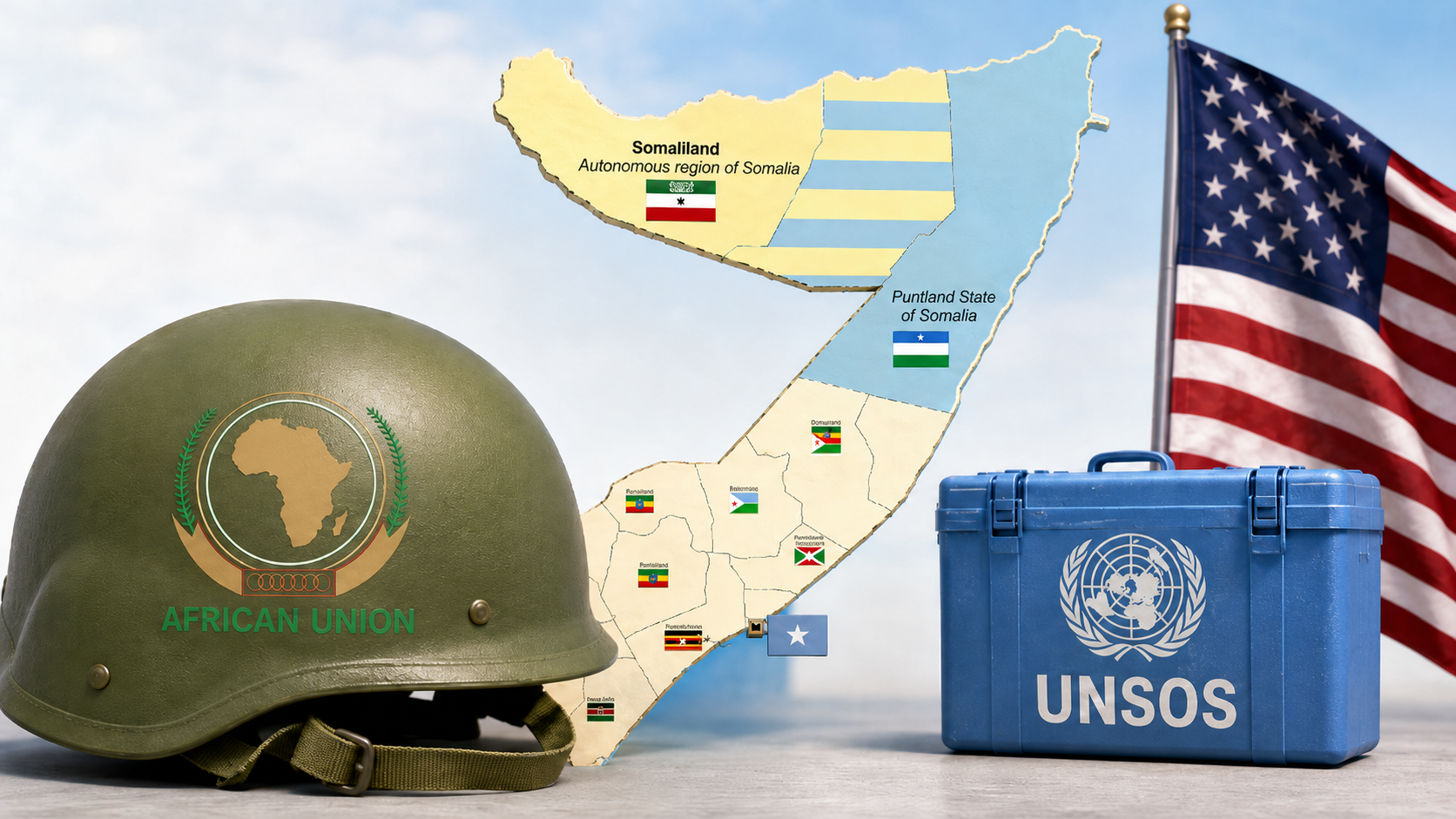
UNSOS cannot be separated from that wider reassessment. In confirming that Washington would not support the office beyond December 31, 2026, the State Department stated that the United States had contributed nearly $2 billion to UNSOS and its predecessor. It argued that Somalia had not sustained the gains made against al-Shabaab or assumed most of its security responsibilities. The office, it said, diverted resources from priorities with “more immediate and direct implications for U.S. interests.”
That language places the Somalia decision squarely within the administration’s transactional framework. Washington is not only asking whether the mission remains useful. It is asking whether that usefulness is sufficiently direct, visible and immediate.
From Predictable Funding for AU Peace Operations to Renewed Uncertainty
Washington’s decision to end support for the United Nations Support Office in Somalia after December 31, 2026, also raises questions about Security Council Resolution 2719, the framework adopted under the Biden administration to provide more predictable financing for AU-led peace support operations.
Adopted unanimously in December 2023, Resolution 2719 allows the Security Council to authorize UN assessed contributions for AU-led operations on a case-by-case basis. A U.S. amendment capped assessed financing at 75 percent of a mission’s annual budget. The AU and UN would jointly mobilize the remainder from the international community.
The resolution was a major policy shift. African forces had long deployed into conflicts authorized or supported by the Security Council while depending on voluntary contributions that arrived late, fell short or changed with donor priorities. Resolution 2719 appeared to place selected AU operations on a more reliable financial foundation.
The Biden administration supported predictable UN financing for AU-led peace operations. The United States introduced the amendment to Resolution 2719 that capped UN-assessed contributions at 75 percent of a mission’s annual budget, with the remaining amount to be jointly mobilized from other sources.
However, when the Security Council authorized AUSSOM in December 2024, Washington abstained over how that framework would be applied in Somalia. The proposed hybrid model would have used UN-assessed contributions to cover up to 75 percent of AUSSOM troop reimbursements while continuing to fund the full UNSOS logistical package separately. The United States argued that this could leave the UN paying more than 90 percent of the combined AUSSOM and UNSOS cost, weakening the burden-sharing principle built into Resolution 2719.
This is therefore not a simple story in which one administration supported every aspect of the Somalia model and the next rejected it. The earlier dispute concerned how to prevent overlapping costs while preserving predictable financing. The current administration has moved further. It will not object to renewal of the AUSSOM mandate itself, but it plans to oppose any renewal that continues UN logistical or operational support.
Resolution 2719 would remain in force, but the Somalia case would weaken confidence in it. If AUSSOM cannot receive the logistical support it needs despite being the first major test of the new financing framework, other AU missions may also doubt whether predictable UN funding will be available when the United States objects to the cost or structure of a mission.
The Challenges of a Mandate Without Logistics or Leverage
Against the backdrop of Washington’s decision to end support for UNSOS, military chiefs from AU
troop-contributing countries met in Kampala on July 29 to seek African-led options for keeping the mission operational. Their search for alternatives exposes the central problem facing AUSSOM. Its mandate may remain intact while the system required to implement it disappears.
To avert that outcome, AU officials are calling for faster African-led arrangements, stronger member-state contributions, fuller use of the AU Peace Fund and predictable, long-term partner financing. The immediate objective is to preserve the mission’s most critical functions while a credible replacement for UNSOS is developed.
AUSSOM is an AU peace support operation, not a conventional UN peacekeeping mission. Yet its mandate depends on a UN logistical system built over nearly two decades. The support office began as UNSOA in 2009, became UNSOS in 2015 and continued through the transitions from AMISOM to ATMIS and then AUSSOM.
UNSOS is authorized to support up to 11,826 AUSSOM personnel deployed across five sectors and 49 locations in an area covering about 400,000 square kilometers. Its support includes food, water, fuel, sanitation, accommodation, defensive infrastructure, engineering, vehicles, aviation, communications, information technology and medical services. It also arranges the deployment, rotation and repatriation of personnel and equipment.
If UNSOS closes or is sharply reduced without a replacement system, these services do not simply become smaller budget items. Fuel deliveries could be interrupted. Vehicles and aircraft could become unavailable. Remote bases could struggle to receive food, water and defensive supplies. Communications could deteriorate, and troop rotations could be delayed. AUSSOM might retain its mandate and personnel while losing the practical capacity to move, communicate, resupply its positions and conduct sustained operations.
The consequences would also extend to explosive-hazard management. UNSOS finances part of the United Nations Mine Action Service’s work in Somalia. UNMAS trains and advises AU personnel, supports the detection and disposal of explosive hazards and helps forces respond to improvised explosive devices. Without replacement financing, the parts of UNMAS support funded through UNSOS could be reduced or interrupted, making troop movements and supply routes more dangerous.
The same problem applies to medical support. UNSOS provides casualty evacuation and medical evacuation from remote operating areas. Field hospitals cannot function as isolated buildings. They depend on aircraft, ambulances, fuel, medical supplies, maintenance and referral arrangements. If those links break down, commanders may become reluctant to send troops into high-risk operations because they cannot be certain that wounded personnel will be evacuated and treated.
UNSOS also provides non-lethal support to as many as 20,900 Somali security personnel participating in joint or coordinated operations with AUSSOM. That assistance includes food, water, fuel, tentage, transport, communications, defensive stores and in-theatre medical evacuation. It is financed through voluntary contributions to a trust fund administered by UNSOS. If the support office disappears, the trust fund and its delivery system would need a new administrator. Without one, Somali forces could also lose the supplies required to participate in joint operations or hold positions transferred to them.
The effect would reach beyond military operations. The former United Nations Assistance Mission in Somalia, now the United Nations Transitional Assistance Mission in Somalia, provides political good offices, mediation, electoral and constitutional support, human-rights assistance, security-sector advice and coordination of international donor support. UNTMIS has a separate mandate and budget from UNSOS and is scheduled to complete its transition by October 31, 2026. Ending UNSOS would therefore not automatically end the political mission.
However, the political influence of the UN mission also depends partly on the wider UN system’s ability to connect political commitments with technical assistance, donor coordination and operational support. When Somali officials raise problems involving security, stabilization, institutional capacity or the extension of government authority, UN political officials can use their relationships with donors and operational agencies to help mobilize a response.
If the UN can no longer help address those practical problems, its political leverage is weakened. Mission leaders may continue urging Somali officials to reach agreements, implement reforms or assume greater security responsibilities. But those officials may respond that they lack the resources required to do so and that the UN is no longer able to help close the gap. Political engagement then becomes harder because UN advice is no longer backed by the same capacity to support implementation. This would be an indirect political consequence of losing UNSOS, rather than a direct budgetary link.
The proposed UNSOS budget for 2025–2026 was approximately $537.2 million. Its scale shows why AUSSOM cannot simply retain its mandate while losing the support office beneath it. UNSOS is not an accessory to the mission. It is the operating system that sustains troops in the field and part of the practical weight behind the UN’s political engagement in Somalia.
U.S. Airpower and the End of UNSOS
UNSOS and U.S. military operations in Somalia are separate, but they operate on the same battlefield. UNSOS sustains AU and Somali forces on the ground. The United States operates through bilateral security cooperation with the Somali government, training and supporting elite Somali units, particularly Danab, and providing airpower against al-Shabaab. U.S. forces continue to conduct airstrikes in coordination with the Somali government, although the locations from which individual operations are launched are not always publicly disclosed. Ending UNSOS would therefore not end the American military presence, but it could leave U.S. forces operating alongside weaker ground partners.
American airpower can serve as a force multiplier for Somali forces and, where coordination exists, AU troops operating against al-Shabaab. When fighters assemble for an attack or threaten to overrun a position, airpower can disrupt their advance and relieve pressure on troops on the ground. However, its effect depends on those ground forces remaining in place to defend bases, secure roads and hold territory after the strike. United States Africa Command (AFRICOM) has previously described U.S. airstrikes as support for Somali ground operations.
The end of UNSOS could weaken that ground presence. UNSOS provides AUSSOM with fuel, transport, aviation, communications, medical evacuation and other operational support. It also provides limited non-lethal assistance to Somali forces participating in joint or coordinated operations with AUSSOM. Without replacement, both forces could conduct fewer offensives, struggle to sustain remote positions and become less able to respond quickly to al-Shabaab attacks.
This would not mean that the United States had agreed to replace UNSOS with airpower. No such policy has been announced. But weakened ground operations could change the demands placed on American forces. If AUSSOM and Somali forces exert less pressure, al-Shabaab may gain more freedom to move, assemble fighters and attack exposed positions. The United States could then receive more requests for air support while also needing to protect its own personnel and facilities from a threat benefiting from the reduced ground presence.
Airpower cannot fill the entire gap. It can disperse fighters, destroy a training site or disrupt an imminent attack. It cannot deliver supplies, rotate troops, secure roads, protect communities or permanently hold recovered territory. The United States could therefore remain active in the air while the wider campaign against al-Shabaab becomes weaker on the ground.
Moreover, future American response is also uncertain because U.S. force posture in Somalia has changed before. During his first administration, President Trump ordered all U.S. military forces withdrawn from Somalia and repositioned elsewhere in East Africa. President Biden reversed that policy in May 2022 by restoring a small but persistent U.S. presence. The Pentagon argued that repeatedly sending personnel into Somalia and then withdrawing them increased risk and reduced operational efficiency.
That history leaves several possible outcomes after UNSOS ends. The Trump administration could maintain the current presence and continue supporting Somali forces. It could face pressure to conduct more airstrikes as AU and Somali ground operations decline. It could also again reposition American personnel elsewhere in East Africa and respond to al-Shabaab mainly from regional bases. No decision has been announced, and continuing U.S. strikes do not establish what Washington will do once UNSOS operations end.
The strain could also affect Somali force cohesion. Soldiers who no longer trust that food, fuel, reinforcements or medical evacuation will reach them may abandon exposed positions. Some could desert or defect if they fear capture or conclude that the state cannot protect them. This is a potential consequence rather than a certain outcome, but it becomes more plausible when a force loses the logistical structure required to sustain it.
The United States may therefore reduce its contribution to multilateral logistics only to face a heavier direct counterterrorism burden. Alternatively, it may withdraw again and attempt to contain al-Shabaab from outside Somalia. Either outcome could leave a wider gap between American airpower and the ground forces required to translate temporary disruption into lasting territorial control.
Operational Consequences of Ending U.S. Support for UNSOS
The first likely consequence would be a smaller operational footprint and possibly a reduction in AU troop numbers. AU contingents cannot remain dispersed across wide areas without reliable food, fuel, water, communications, transport and medical cover. Commanders could be forced to close forward operating bases and concentrate forces around Mogadishu, major towns and a smaller number of strategic installations. That would create a security vacuum in places where Somali forces have struggled to hold recovered territory without sustained logistics, stabilization and a functioning government presence. The Security Council was warned in 2026 that territorial gains remained vulnerable to reversal when those supporting conditions were absent.
Joint AU-Somali operations could slow or stop. Somali units that receive support during coordinated operations depend on fuel, rations, transport, communications and medical evacuation. Without those services, forces may be able to enter an area but lack the capacity to remain there after territory is recovered.
Medical uncertainty would affect decisions before any hospital formally closed. Commanders may hesitate to authorize high-risk operations if they cannot guarantee evacuation and treatment. Soldiers may also be less willing to deploy if the system for reaching field hospitals or external medical facilities is no longer reliable.
Al-Shabaab would not need to defeat every remaining base. It could exploit reduced patrols, weakened supply routes and the spaces between a smaller number of positions. The group could regain freedom of movement, expand taxation and recruitment networks, and place new pressure on towns that AU and Somali forces can no longer sustain.
A second consequence could arise if troop-contributing countries or other regional security partners agree to remain through bilateral arrangements or temporarily absorb their own costs. Somalia has limited fiscal capacity to reimburse foreign forces in cash. Negotiations could therefore shift toward access to contracts, infrastructure or future resource projects. Turkey is not an AUSSOM troop contributor, but its expanding role shows how security and economic engagement can develop together: a defence and economic agreement was followed by agreements on oil and gas exploration. The point is not that every partner would demand natural resources. It is that replacing one multilateral financing framework with separate bilateral bargains could weaken Somalia’s negotiating position.
These outcomes are risks rather than certainties. But they follow directly from the functions that would disappear unless another institution takes them over.
The Counterterrorism Contradiction Under Trump 2.0
The Trump administration now relies on entry restrictions as part of its effort to mitigate terrorism and other security risks linked to Somalia. Under Presidential Proclamation 10998, effective January 1, 2026, the United States fully suspended most immigrant and nonimmigrant visa issuance to Somali nationals, subject to limited exceptions. Somalia was also included in a separate pause affecting immigrant visa applicants from 75 nationalities.
These measures may reduce direct access to the United States for a period, but they are not a substitute for containing the organization that generates the threat. They are also administration-dependent and can be changed by a future government. A threat actor does not have to travel directly from Somalia or on a Somali passport. Transnational networks can recruit supporters abroad, inspire individuals online and exploit routes through countries that are not subject to the same restrictions.
The 2026 U.S. intelligence assessment indicates that stronger border enforcement had reduced access to the homeland, but it also warned that terrorist groups were increasingly using propaganda to inspire or enable people already in, or able to reach, Western countries. The same assessment described Africa as a focal point for global jihadist activity and said al-Shabaab had advanced toward Mogadishu while coordinating funding and propaganda with al-Qaeda elements in Yemen. The National Counterterrorism Center also states that the group operates mainly in Somalia, Kenya and Ethiopia and has carried out mass-casualty attacks beyond Somalia.
Ending UNSOS support could therefore weaken another layer of protection. If AU and Somali offensives slow because troops lose transport, fuel, medical evacuation and other support, al-Shabaab could gain time and space to regroup, recruit, raise revenue and expand its violence. U.S. Africa Command says its strikes are intended to degrade the group’s ability to threaten U.S. forces and American citizens abroad. Keeping sustained pressure on al-Shabaab in Somalia does not eliminate every terrorist risk, but it limits the territory, resources and operational freedom from which broader threats can grow. Border controls may restrict one route into the United States. Sustained pressure on al-Shabaab reduces the threat at its source.
The Dilemmas of the December 2026 Deadline
The funding dispute has reached a critical point before Somalia, the AU and their partners have produced a credible alternative. If the United States follows through on its announced decision to end support after December 2026, much will be at stake, including AUSSOM’s operational continuity, the future of the security transition and nearly two decades of gains against insurgent groups.
The European Union is the mission’s other major financial pillar. In April 2026, it approved an additional €75 million for AUSSOM, mainly for troop allowances, non-lethal equipment and related services. This brought total EU support to successive AU missions in Somalia since 2007 to almost €2.8 billion.
But EU funding cannot replace the logistical system provided by UNSOS. Paying troop allowances has limited value if troops lack fuel, transport, communications, medical evacuation and reliable supplies. The end of UNSOS could therefore make continued European financing harder to justify and increase the risk that AUSSOM is reduced or ends before Somalia is ready to assume full security responsibility.
A July 2026 Balqiis Insights paper argues that the discussion is no longer about a successful transition. It is about a dignified, managed exit that prevents insurgents from reversing nearly two decades of security gains. The authors say 18 months of warnings did not produce a credible contingency plan.
Washington is not solely responsible for this failure. Somalia’s political divisions have repeatedly weakened national security planning. The U.S. diplomatic note cited internal rivalries and political infighting as obstacles to the campaign against al-Shabaab and ISIS-Somalia. The AU has also failed to secure a durable financing system for a mission that has depended on external partners for its most important operational functions. A form of donor fatigue has set in after nearly two decades of successive missions, repeated transition deadlines and continuing requests for emergency financing without a credible end state.
The present transition has deeper roots. Under President Mohamed Abdullahi Mohamed Farmajo, Somalia adopted a conditions-based Transition Plan in 2018 to transfer responsibility from AMISOM to Somali forces. The government promoted Somali-led operations and joint offensives as evidence that national forces could become the primary security provider. Even then, the UN warned that there was little value in liberating towns only to see them return to al-Shabaab. A successful handover required logistics, stabilization, governance and the ability to hold recovered areas after military operations ended.
AUSSOM is also a multidimensional coalition without one political or operational centre. Somalia, the AU Commission, the Security Council, UNSOS, troop-contributing countries, federal member states and bilateral donors control different parts of the mission. They do not always share the same timetable or interests. Each actor is also trying to protect its forces, finances, regional influence or domestic political position. This fragmentation makes one universal decision difficult and helps explain why repeated warnings have not produced one executable contingency plan.
UNSOS should also be distinguished from UNSOM, the UN political mission that was renamed the United Nations Transitional Assistance Mission in Somalia, or UNTMIS, in November 2024. UNSOM and UNTMIS have supported state-building, elections, human rights, rule of law, security-sector reform and coordination of international assistance. Humanitarian relief is delivered mainly through UN agencies and partners rather than by the political mission itself. UNSOS provides the administrative and logistical platform that allows UNTMIS to maintain offices and personnel across Somalia. UNTMIS is scheduled to close on October 31, 2026, two months before UNSOS support is due to end.
Somalia must eventually assume responsibility for its security. The question is whether removing logistics before replacement capacity exists will create ownership or simply produce operational collapse.
Limited and Difficult Alternatives
The AU can seek new donors. The European Union, the United Kingdom, Gulf states, Turkey, China and other partners could finance specific parts of the mission. But replacing UNSOS is not the same as filling one budget line. A replacement would need aviation contracts, medical networks, warehouses, procurement systems, engineering, communications, transport and a mechanism for reimbursing troop-contributing countries.
A patchwork of bilateral arrangements might preserve some services. It could also create different standards, contracts and reporting systems without one logistical command. The mission might receive money for food but not aviation, or fuel without medical evacuation. Separate agreements with troop-contributing countries could also turn deployment decisions into bilateral negotiations over strategic or economic benefits.
AUSSOM could reduce its size and concentrate around Mogadishu, major towns and critical transport routes. This would lower logistical requirements, but it would also surrender operating space and leave more communities exposed.
A managed exit is another option. It would require decisions on which bases should close, how troops and equipment would be withdrawn, which facilities would transfer to Somali authorities and how supply routes would be protected during the drawdown. Even leaving requires aviation, convoy support, medical cover and logistics.
None of these options provides a complete or immediate substitute for UNSOS. New donors could preserve selected services, a smaller mission could reduce costs, and a managed exit could limit disruption. But each option requires political agreement, financing, contracts and operational planning before UNSOS closes. Without that preparation, the December 2026 deadline could produce not a security transition, but an unmanaged collapse of the support system sustaining AUSSOM.
Policy Recommendations
The withdrawal of U.S. support for UNSOS should not lead either to another indefinite extension or to an abrupt collapse of the mission’s support system. A final transition compact should combine a fixed deadline with limited bridge support, clearer burden-sharing and defined responsibilities for Somalia, the AU and international partners.
1. Negotiate a time-limited UN-delivered logistics bridge
The United States has the right to redirect its resources toward priorities it believes more directly benefit Americans. It should, however, distinguish between ending an open-ended commitment and abruptly disabling the support system through which AU and Somali forces help contain al-Shabaab.
UNSOS is not a U.S. counterterrorism operation, but it indirectly advances American counterterrorism objectives by sustaining forces that hold territory and maintain pressure on the group. Washington should therefore support a phased and conditional withdrawal lasting no more than two years.
During that period, the Security Council should preserve only the most critical and difficult-to-replace functions. These should include casualty and medical evacuation, fuel, rations, strategic transport, communications, equipment movement and UNMAS support. The bridge should have a fixed end date and no presumption of automatic renewal.
2. Redesign the application of Resolution 2719
Washington’s concern about overlapping UN costs should be addressed through one combined mission budget and one transparent support package. The purpose should be to identify which costs fall under AUSSOM and which fall under the UN logistical system, while preventing the same service from being financed twice.
The answer should be to correct the financing structure, not to leave the 75 percent framework intact on paper while removing the logistics required for its first major test.
3. Tie bridge funding to one costed Somali-AU transfer plan
Somalia and the AU should identify which bases, routes and functions Somali forces can realistically assume, when each transfer should occur and what support will still be required afterward.
Progress should be reviewed regularly against force readiness, federal-state coordination, command arrangements, payroll controls, logistics management and the ability to hold recovered territory. Transfers should be based on verified capacity rather than an externally imposed calendar. Where Somali forces are not ready, the plan should state whether a position will be retained temporarily, reduced or closed.
4. Build a long-term coalition of predictable partners
The AU should urgently seek partners willing to enter financing and security-support agreements lasting at least five years. Responsibilities for troop allowances, aviation, medical evacuation, transport, communications, equipment and training could be divided among partners through clearly defined commitments.
The AU must also be prepared to adjust the mission to match the resources available. This may require reducing troop numbers, concentrating forces in strategically important locations and asking troop-contributing countries to assume a larger share of personnel costs. Contributing countries could continue paying national salaries and provide additional deployment allowances, while other African states contribute financing, equipment or logistical capabilities.
Somalia and the AU could also negotiate bilateral agreements with countries willing to provide military assistance from their own budgets. However, all such support should operate within one Somali-AU strategic framework. Otherwise, different partners could establish competing command arrangements, reporting systems and security priorities shaped by their own political or economic interests.
5. Make bilateral security agreements transparent
Any country that finances troops or provides direct military and logistical support should disclose the terms of that assistance. Security support should not be tied to undisclosed access to ports, military bases, procurement contracts or future natural-resource concessions.
Transparency would not prevent Somalia from forming strategic partnerships. It would help ensure that short-term military needs do not result in long-term concessions that weaken Somali sovereignty or create competing foreign agendas within the same security operation.
6. Increase African financial ownership of peace operations
The AU should require member states to make regular and predictable contributions specifically for African peace and security operations. Contributions should reflect economic capacity, with larger and resource-rich economies carrying a greater share. Governments that do not contribute troops should provide more financial, logistical or technical support.
African financing is unlikely to replace the full cost of UNSOS or other major external contributions in the near term. The more realistic objective is to establish a protected African-funded core capable of sustaining essential functions when donor support declines. External partners could then finance specific capability gaps rather than carry most of the mission.
The experience of AMISOM shows why this matters. Its transition was driven in large part by donor fatigue, declining financial support and pressure to establish an exit strategy for a mission that appeared to have no clear endpoint. The transition did not begin because al-Shabaab had been defeated or because Somali forces were fully ready to assume responsibility. Financing pressures helped accelerate troop reductions while the insurgency remained active.
Greater African financing would not eliminate the need for international support. It would give the AU more authority to challenge transition schedules that do not reflect conditions on the ground. Without meaningful financial ownership, African peace operations will continue to be shaped as much by donor exhaustion as by security realities.
The compact would impose a real endpoint while recognizing that a safe transition requires both logistics and sustained political commitment. It would give Somalia and the AU one final opportunity to build a credible national security arrangement, diversify their partnerships and reduce the power of external donors to determine mission timelines through funding decisions alone.
Conclusion
Somalia offers Washington limited immediate commercial opportunity partly because it remains insecure. Yet withdrawing support from the system containing that insecurity makes future trade, stabilization, investment and American influence even less attainable.
The United States has legitimate grounds to demand more Somali ownership, stronger political coordination and wider burden-sharing. It also has the right to stop financing arrangements that it believes no longer deliver sufficient value to American taxpayers. But a right to withdraw does not make an abrupt withdrawal strategically wise.
Visa restrictions and airstrikes can address particular risks . Neither can replace the forces and logistics that hold territory, sustain pressure on al-Shabaab and prevent the group from rebuilding between operations. If UNSOS closes before a replacement system is operating, Washington may save money immediately while weakening the counterterrorism architecture that has indirectly served U.S. interests for nearly two decades.
A phased and conditional withdrawal would better align American fiscal priorities with American security interests. It would give Somalia and the AU a final period to assume critical responsibilities, broaden the donor base and prepare an orderly exit if the mission cannot continue.
The UNSOS decision will determine more than the future of one mission. It will show whether the predictable-financing framework created by Resolution 2719 can survive an American policy that values multilateral security support only when its benefits are immediate and visible.
Somalia has no easy deal to offer Washington. Peacekeeping may not produce an immediate commercial return, but its value lies in the territory al-Shabaab cannot seize, the attacks it cannot organize and the larger crisis the international community does not have to confront later.
For collaboration, media inquiries or expert commentary, contact ruth@africathroughwashington.com