Africa should neither treat Washington’s renewed interest in critical minerals as a favor nor reject it as another scramble for resources. It should use this moment to negotiate a different bargain. Access to cobalt, copper, lithium, graphite and other strategic minerals must be matched by investment in processing, infrastructure, skills, jobs, public revenue and visible improvements in people’s lives. American supply chains may become more secure, but Africa must also become more industrial, more prosperous and less dependent on exporting raw materials.
Critical minerals now sit at the centre of the industrial and national-security competition shaping relations between the United States (U.S.) and Africa. Copper, cobalt, graphite, lithium, manganese, nickel, rare earth elements and platinum group metals are needed for electricity networks, batteries, data centres, aircraft, advanced manufacturing and modern defence systems. The 2025 United States critical-minerals list contains 60 minerals and newly includes copper and uranium. The list reflects a broader shift. Access to minerals is no longer treated only as a commercial concern. It is now part of economic security, military readiness and technological power.
In July 2026, a White House determination on recoverable critical minerals and materials (CMMs) underscored the national-security rationale, warning that “America’s inadequate supply of CMMs poses an increasing risk to our national defense and security.”
Africa’s importance lies in both the scale of its mineral endowment and the fact that several of its producers are already indispensable to global supply chains. For Washington, the continent offers a way to reduce excessive dependence on China and build more diversified sources of critical minerals. But diplomatic declarations will not be enough. The United States will need to compete through exploration finance, equity investment, long-term purchasing agreements, processing capacity, reliable energy, transport infrastructure and meaningful partnerships with African companies.
African governments should not reject this opening merely because Washington is acting in its own interest. Every state seeks secure access to strategic inputs. The stronger response is to negotiate from Africa’s own interests. Mineral agreements should be judged by whether they expand productive capacity, strengthen public institutions and convert finite resources into lasting development.
Why African Critical Minerals Matter to Washington and the Geopolitical Contest
Africa’s mineral potential has become a geopolitical priority for Washington because the challenge is not only where critical minerals are mined, but also who controls their processing and movement into global supply chains. China is the leading refiner for 19 of the 20 strategic minerals assessed by the International Energy Agency, with an average market share of about 70 percent. It also occupies dominant positions in battery materials, rare-earth separation and permanent magnets. This means that minerals may be mined in Africa, Latin America or Australia and still pass through Chinese-controlled processing before reaching manufacturers.
African suppliers offer Washington a chance to diversify both extraction and processing. The Democratic Republic of the Congo (DRC) is central to global cobalt production and is also a major copper producer. Zambia is a leading copper state. Guinea is indispensable to bauxite supply. South Africa is strategically important for platinum group metals, manganese and chromium. Graphite resources in Madagascar, Mozambique and Tanzania could support alternative battery-anode supply chains. Uranium in Namibia and rare-earth prospects across several countries widen the strategic field.
Johns Hopkins SAIS Foreign Policy Institute Director Carla Freeman captured the strategic shift in July 2026, observing that “Africa holds a huge share of the critical minerals the world now needs.” She noted that China’s earlier infrastructure relationships in Africa have become strategic advantages as global demand for these minerals has risen.
The competition is broader than a simple U.S.-China contest. Australian and Canadian companies are prominent in African exploration. British and European firms hold major assets. Gulf investors are expanding into mining, infrastructure and commodity trading. The ownership pattern across African mines is therefore more mixed than the common claim that China owns Africa’s minerals. China’s deeper advantage lies in integration. Its state-linked banks, engineering companies, mines, processing facilities and purchasing networks can work as parts of one commercial system.
Washington must compete with that system rather than merely criticise it. It does not have to reproduce every Chinese financing structure. It does need to combine its development-finance institutions, private companies, export-credit tools, technology and diplomatic influence into offers that can move from feasibility studies to operating mines, power systems, processing plants and railways.
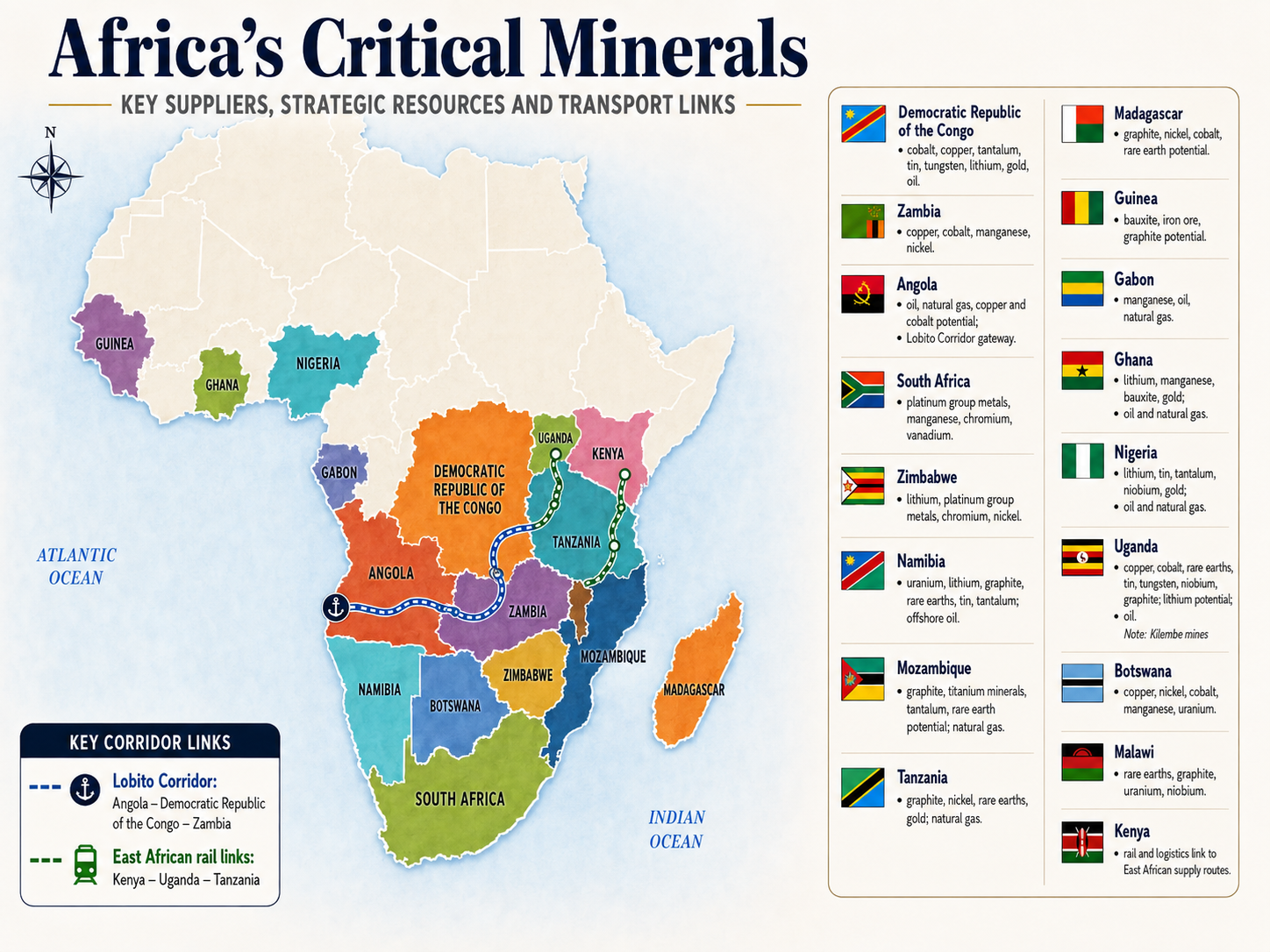
Mapping Africa’s Potential Critical Mineral Suppliers
Africa’s mineral opportunity is large but should be described carefully. Resource estimates are not the same as proven reserves, and a geological occurrence is not automatically a commercial mine. Even with those qualifications, the continent’s scale is clear. An Africa Finance Corporation study estimates Africa’s mine-site mineral endowment at about $29.5 trillion, equal to roughly one-fifth of global mineral wealth. The Organisation for Economic Co-operation and Development (OECD) estimates that African exports of raw and semi-processed critical minerals reached nearly $266 billion in 2023. The policy problem is that much of the higher value created through refining, specialised materials and manufacturing is captured elsewhere.
Central Africa and the Copperbelt
The DRC and Zambia form the core of the Central African Copperbelt. The DRC supplies cobalt, copper, tantalum, tin, tungsten and gold, with lithium prospects and a small oil sector. Zambia’s strategic base is copper, supported by cobalt, manganese and nickel potential. Angola is the Atlantic gateway for the region through the Lobito Corridor. It is principally an oil and gas producer, but it is also promoting exploration in copper, cobalt, manganese and rare-earth prospects. These three countries could support an integrated corridor combining mines, electricity, processing, logistics and export access.
Zambia is also showing how quickly a large new project can become a strategic signal. At the May 2026 Mingomba groundbreaking, KoBold Metals Africa CEO Mfikeyi Makayi said, “We cannot afford to go slow. We must go fast, we shall go fast, and we will not take shortcuts.”
Southern Africa
Southern Africa’s broad mineral portfolio includes South Africa’s platinum group metals, manganese, chromium and vanadium, supported by established mining finance, engineering and processing capacity. Zimbabwe is a major lithium producer and also holds platinum group metals, chromium and nickel. Namibia contributes uranium and has lithium, graphite, rare-earth, tin and tantalum prospects, alongside major offshore oil discoveries. Botswana has copper, nickel, cobalt, manganese and uranium potential. Malawi has rare-earth, graphite, uranium and niobium projects. Mozambique is important for graphite and titanium-bearing minerals and also has substantial natural-gas resources.
Eastern Africa
Eastern Africa’s graphite, nickel and rare-earth potential includes Tanzania’s graphite, nickel, gold and rare-earth prospects and Madagascar’s graphite, nickel and cobalt operations. Uganda has a more varied but less developed portfolio. It has copper and cobalt at Kilembe, together with tin, tungsten, niobium, graphite, lithium and rare-earth potential. Uranium should be described as exploration potential and reported occurrence, not as a proven major commercial reserve. Uganda also has oil in the Albertine Graben, which is strategically important but is not a critical mineral.
Uganda’s most important current example is the redevelopment of the Kilembe copper and cobalt mines. In March 2025, the government signed a mineral production-sharing agreement that envisages copper cathodes and cobalt metal rather than the export of untreated ore alone. Uganda has also created a state mining company and adopted a framework that allows a 15 percent free-carried state interest in mining operations. These measures place Uganda within the wider African debate over state ownership, processing and local value.
Kenya’s immediate strategic importance is less about being a dominant mineral supplier and more about logistics. Its port, railway and industrial infrastructure can connect East African production to international markets. Kenya can also support laboratories, engineering services, finance and regional manufacturing. That makes it an important supply-chain partner even where its own mineral output is smaller than that of the DRC, Zambia, South Africa or Zimbabwe.
West Africa
West Africa’s bauxite, manganese and emerging lithium base includes Guinea’s bauxite and large iron-ore deposits, Gabon’s manganese, Ghana’s manganese, bauxite, gold and lithium projects, and Nigeria’s lithium, tin, tantalum, niobium and gold potential. Gabon, Ghana and Nigeria also produce oil or natural gas. These countries illustrate why critical-mineral strategy should not be separated entirely from energy, ports, electricity systems and the broader industrial base.
This distribution also creates an opening for regional value chains. A mine may be located in one country, the most reliable electricity in another, the processing plant in a third and the export port in a fourth. The African Continental Free Trade Area (AfCFTA) could support such arrangements, but only if governments align customs procedures, transport rules, power markets, taxation and standards.
Washington’s New Investment Signal
The $500 million U.S.-Africa Strategic Investment Program is the clearest recent evidence that Washington wants to turn mineral diplomacy into implementable projects. The Department of State programme anticipates approximately ten awards of between $5 million and $50 million, normally lasting 12 to 36 months. Funding remains subject to availability, which means the $500 million is a ceiling rather than proof that the entire amount has already been awarded.
The United States International Development Finance Corporation CEO Ben Black put Africa’s strategic role more directly in April 2026, saying that “the future of global growth and supply chains will run through Africa.” He linked that opportunity to critical minerals, energy, infrastructure and logistics.
The programme seeks U.S. and U.S.-aligned companies, non-profit organisations and public international organisations capable of designing and implementing projects. Its mineral priorities include geological data, local processing, workforce development, regulatory reform, feasibility work, transaction support and the identification of energy, transport and logistics barriers. It is not a construction fund. Large mines, railways, power plants and refineries will still require finance from the United States International Development Finance Corporation (DFC), the Export-Import Bank of the United States, private investors, African institutions and commercial lenders.
The programme is therefore best understood as a project-development and risk-reduction platform. It can help governments identify viable assets, prepare transactions, improve regulation and train workers. It will demonstrate seriousness only when prepared projects can move into financing and construction. African governments have repeatedly seen studies completed without the capital needed for implementation.
Congress has shown wider concern about U.S. dependence on concentrated mineral supply chains, including through hearings on breaking China’s critical-mineral dominance. However, no clear public congressional endorsement of this exact $500 million funding ceiling had emerged when the programme was announced. Congress retains appropriations and oversight authority. Washington should therefore distinguish political ambition from money already obligated.
The Lobito Corridor as the Leading Test
The Lobito Corridor is the leading test of whether Washington can connect mineral access to physical infrastructure. It stretches from the Atlantic port of Lobito in Angola through the DRC Copperbelt and toward Zambia. Because Angola and Zambia are in Southern Africa while the DRC is in Central Africa, the corridor links the two regions rather than belonging neatly to only one.
The existing Angolan railway runs about 1,300 kilometres from Lobito to the DRC border. DFC has provided a $553 million loan for rehabilitation of the railway and mineral port. Together with financing from the Development Bank of Southern Africa (DBSA), the project reached a $753 million financial close. The investment is expected to increase transport capacity to about 4.6 million tonnes and reduce mineral-transport costs.
The wider plan requires new construction and rehabilitation beyond Angola. The proposed greenfield link toward Zambia is roughly 800 kilometres and may cost between $3 billion and $5 billion. Current plans seek financial close in late 2027 and target completion around 2030. Those dates remain projections. Financing, land acquisition, environmental reviews, border coordination and construction risks could extend the timetable.
That corridor logic is already shaping other U.S.-backed spending. In June 2026, Zambia’s Ministry of Finance said that “The realignment will support both Zambia’s agricultural and critical minerals economy in the Lobito Corridor.”
Lobito’s immediate reach is regional, but it could eventually connect with a wider African transport system. Zambia already sits at the intersection of routes leading south toward Zimbabwe and South Africa and east toward Tanzania. The Tanzania-Zambia Railway Authority (TAZARA) provides an Indian Ocean outlet through Dar es Salaam, although it requires substantial modernisation. A functioning Atlantic route would give producers alternative ports and reduce dependence on any one corridor.
East Africa is also expanding its railway network. Kenya launched the 264-kilometre Naivasha-Kisumu and 107-kilometre Kisumu-Malaba sections of its standard gauge railway (SGR) in 2026. Uganda is implementing the 272-kilometre Malaba-Kampala SGR, with later routes planned toward Rwanda, South Sudan and the DRC. Tanzania is building an electrified SGR from Dar es Salaam toward inland centres, while the African Development Bank is supporting a Tanzania-Burundi-DRC railway connection along the Central Corridor.
If completed and coordinated, these railways could move mining machinery, fuel and construction materials into production areas and carry concentrates, refined minerals and manufactured components toward Atlantic and Indian Ocean ports. They could also support regional processing by allowing ore from one country to reach power, skills or industrial facilities in another. Yet there is no seamless railway across the continent. Missing links, different gauges, weak maintenance, border delays and inefficient customs systems remain major obstacles.
Lobito also signals a change in the American approach. Earlier U.S. engagement in Africa was often most visible through health programmes, humanitarian assistance, governance support and capacity building. The present policy language emphasises trade and investment over traditional assistance. China has long bundled finance, contractors, infrastructure and commodity access. Resource-backed structures in Angola and the DRC showed how future oil or mineral earnings could support infrastructure finance. The American model is different. Lobito combines development finance, private operators, European support and African institutions. But it is clearly attempting to match China’s ability to turn diplomacy into visible construction.
The corridor should not be judged only by tonnes of minerals exported. A successful development corridor would provide open access, transparent tariffs, feeder roads, reliable electricity, water systems, digital infrastructure, border facilities, industrial zones and opportunities for farmers and local businesses. A faster railway that only carries unprocessed minerals to the Atlantic would strengthen U.S. supply security without transforming the African economies that host it.
The Democratic Republic of the Congo and the Bargain in Its Hardest Form
The DRC combines extraordinary mineral importance with weak state capacity, armed conflict and mass poverty. It supplies more than 70 percent of mined cobalt and is one of the world’s largest copper producers. It also has gold, lithium prospects and the minerals commonly known as the 3Ts: tin, tantalum and tungsten. Yet the World Bank estimates that 81.1 percent of the population lived below $3 a day in 2025. Mining drives growth but creates too few jobs for the size of the population.
The formal mining economy is concentrated mainly in Haut-Katanga and Lualaba. Large copper and cobalt projects involve multinational investors, Chinese operators and joint ventures with Gécamines, the state-owned mining company. The government may hold equity, mineral rights or marketing rights without controlling daily operations. This distinction matters. State ownership on paper does not automatically produce operational control, transparent revenue or public benefit.
Industry leaders make the same strategic case from the operating side. In June 2025, Mark Davis, then CEO of Kamoto Copper Company and Glencore Copper Africa, said that “the DRC has an important role to play in supplying these critical minerals” as demand for copper and cobalt remained strong.
Eastern DRC presents a different mineral economy. Gold and the 3Ts are produced in areas where armed groups, smuggling networks and weak administration overlap. The United States Treasury has documented how armed groups tax and trade minerals from conflict-affected areas. Rubaya in North Kivu is especially important for tantalum. Its inclusion among assets discussed under the U.S.-DRC framework exposed a sharp contradiction because the deposit remained under M23 control. A government cannot guarantee investor access to territory it does not securely govern.
Access to Congolese assets is also changing. The U.S.-DRC Strategic Partnership Agreement created a Strategic Asset Reserve covering an evolving list of critical-mineral assets, gold assets and exploration areas. U.S. investors receive a right of first offer on designated projects. The agreement also links mineral access to local value addition, infrastructure and industrial transformation. DFC has separately explored participation in ventures involving Gécamines and private commodity partners.
Implementation is now becoming a test in its own right. In September 2026, DRC Economy Minister Daniel Mukoko Samba said the new bilateral task force should turn the partnership into “concrete economic and security results” for Congolese citizens, Reuters reported.
Minerals have also become entangled with peace diplomacy. President Félix Tshisekedi’s allies proposed a security partnership tied to improved U.S. mineral access as the government sought stronger help against the Rwanda-backed M23 rebellion. The United States later brokered agreements involving the DRC and Rwanda and paired that diplomacy with a strategic mineral partnership. There is no solid evidence that Washington committed U.S. combat troops to fight M23. The actual instruments have centred on mediation, sanctions, diplomatic pressure, investment and security cooperation.
This makes the DRC the hardest test of the bargain. Washington cannot treat mineral agreements as a substitute for security, legitimate institutions or local consent. Kinshasa cannot use foreign interest as a substitute for transparent licensing, parliamentary scrutiny and accountable management of state assets. The standard of success must be whether mineral wealth produces electricity, schools, roads, jobs, public revenue and safer communities, not simply whether more ore reaches foreign buyers.
Africa’s Push Beyond Raw Mineral Exports
African resistance to exporting raw minerals is growing. The African Union Green Minerals Strategy calls for value addition, local beneficiation, regional industrialisation, employment and stronger participation in mineral value chains. Governments are increasingly using export restrictions, processing requirements, state equity, marketing rights and local-content rules to retain more value.
The African Union has stated that ambition in unusually direct terms. In January 2026, AU Commissioner Francisca Tatchouop Belobe said, “The strategy for African countries is clear: Own the value chain.” The AU framed value addition, green industrialisation and regional integration as central to that strategy.
Zimbabwe has restricted exports of unprocessed lithium. Namibia has limited exports of selected unprocessed critical minerals. Tanzania has used restrictions affecting mineral concentrates. Ghana has required local processing within its lithium framework. Malawi has introduced controls on selected raw mineral exports, and Gabon has announced plans to move beyond raw manganese exports. The wider trend is consistent with a global increase in export restrictions on critical raw materials.
Resource nationalism is not inherently anti-investment. Governments have a legitimate duty to obtain a fair return from finite national assets. State equity can create dividends and strategic influence. Processing rules can build technical capability. Local-content requirements can create African suppliers. Export controls can push investors to examine facilities they would otherwise place abroad.
These policies can also fail. An export ban cannot make a refinery viable where electricity is unreliable, water is scarce, transport is expensive or production volumes are too small. Sudden restrictions can interrupt legitimate businesses and encourage smuggling. State-owned companies can become channels for patronage when appointments, contracts and accounts are opaque. Local-content rules can reward politically connected importers instead of capable domestic manufacturers.
The strongest approach is phased and regional. A government should identify which stages of a value chain can be performed competitively at home and which require collaboration with neighbours. Africa does not have to manufacture every finished product from every mineral. It should, however, capture more concentration, smelting, refining, chemical conversion, component manufacturing, equipment servicing and recycling where the economics support it.
Veronica Bolton Smith, CEO of the Critical Minerals Africa Group, made the development question explicit in August 2026: “Africa should begin by defining critical minerals based on its own development priorities.” Her point is important because a mineral can be strategic to Washington and still fail to advance African industrialisation if the surrounding policy is designed only around external demand.
Challenges Facing Washington
China’s established role is the most visible obstacle. Chinese companies and lenders have years of experience combining mine development, engineering, infrastructure, processing and long-term purchasing. Between 2013 and 2021, Chinese institutions financed far more major international infrastructure than the United States in sectors examined by the U.S. Government Accountability Office comparison. Washington does not have to outspend Beijing everywhere, but it must make its own financing faster, more coordinated and easier to move from approval to construction.
Infrastructure is a second challenge. A deposit is not an investable project without power, water, roads, railways, ports and digital systems. Processing requires even more reliable energy than extraction. Washington cannot encourage African value addition while declining to finance the infrastructure that makes it possible.
Political and regulatory risk is a third challenge. Licences may be contested, fiscal terms can change after investment, elections can delay decisions and conflict can make an asset inaccessible. Weak governance creates losses on both sides. African states lose revenue through poor contracts, transfer pricing, smuggling and corruption. Investors face unpredictable approvals, informal charges and reputational exposure.
African expectations are also changing. Governments increasingly seek equity, processing, local procurement, technology transfer and employment guarantees. An offer centred only on buying minerals will struggle against partners prepared to finance broader packages. At the same time, African governments must recognise that mines and refineries require large upfront investments and long repayment periods. Projects will not proceed where rules change abruptly or ownership demands make commercial financing impossible.
In September 2026, CSIS mining economist Gracelin Baskaran told Congress that the United States has an opportunity to offer mineral-producing countries a partnership built not simply on resource access, but on “investment, value addition, and shared economic growth.” That standard closely matches the bargain African governments are increasingly seeking.
Washington’s wider relationship with Africa may also complicate its mineral strategy. Travel bans, visa restrictions, the permanent visa bond of up to $20,000 and the transfer of some visa processing to regional consular hubs can weaken trust among countries the United States wants as long-term mineral partners. The U.S. has legitimate security and immigration interests. It should pursue them without unnecessarily restricting the businesspeople, officials, engineers, students and technical specialists needed to build the partnerships supporting its industrial base.
Opportunities for U.S. Companies and African Partners
The opportunity extends well beyond mine ownership. U.S. companies can provide geological surveying, remote sensing, drilling technology, laboratory services, mine safety systems, environmental monitoring, digital traceability and cybersecurity. African geological agencies and universities can become long-term partners rather than recipients of short consulting assignments.
Energy and infrastructure offer another field. Companies can develop generation, transmission, water systems, rail equipment, logistics centres and port technology. Mines can serve as anchor customers for power projects that also supply nearby communities and industrial users. Corridors can support agriculture and manufacturing when access rules prevent them from becoming closed mineral routes.
Processing opportunities should be selected on commercial evidence. They may include copper cathodes, cobalt chemicals, graphite purification, battery materials, selected rare-earth separation, metal recycling and the manufacture of intermediate components. Not every project will be viable in every country. Regional plants may be more efficient than duplicating expensive facilities across small national markets.
Finance is equally important. Political-risk insurance, export-credit guarantees, blended finance and long-term purchasing agreements can make strategic projects bankable. Joint ventures can combine U.S. technology and capital with African mineral rights, labour, firms and market knowledge. Local partnership must be substantive. African companies should participate as shareholders, contractors, manufacturers and technical providers, not merely as nominal intermediaries used to satisfy local-content rules.
What Washington Should Offer
Washington should offer complete investment packages rather than isolated requests for mineral access. Technical assistance should connect directly to project finance. Geological mapping should lead to transparent transactions. Feasibility studies should be followed by realistic financing pathways for electricity, transport and processing.
The United States should provide long-term finance and risk guarantees for commercially sound infrastructure. DFC, the Export-Import Bank of the United States and private lenders should work with African development institutions to distribute political, construction and market risk. Faster decisions will matter. African governments will not wait indefinitely while competing partners make executable offers.
Washington should support processing in Africa where it is economically viable. It cannot call for partnership while assuming that the highest-value stages must occur in the United States. Shared supply chains would be more credible. African plants could produce refined or intermediate materials under long-term contracts with American manufacturers.
That is also the message African institutions are taking to investors. In September 2026, African Development Bank President Sidi Ould Tah said, “We want to develop processing capacity, industrial production and sustainable value chains on the continent in the critical minerals sector.” The Bank presented local value creation as part of supply-chain security and long-term competitiveness.
Long-term offtake agreements, minimum-volume commitments and carefully designed price-support tools can reduce uncertainty. These arrangements should preserve commercial discipline and avoid locking African producers into unfair prices. They should provide enough predictability to finance strategic projects without transferring all market risk to governments.
Skills and institutional capacity should be financed at scale. Training should cover geology, engineering, metallurgy, equipment maintenance, environmental regulation, contract negotiation, mineral economics and public-revenue management. Mobility is part of that offer. Carefully screened business, training and technical travel channels would protect U.S. security while supporting the exchanges required by mineral partnerships.
Washington should also apply transactional policy in both directions. Mineral access cannot be the concrete American benefit while governance seminars and promises of future investment are presented as Africa’s equivalent return. The African side of the transaction must include financed infrastructure, viable processing, skilled work, technology, public revenue and opportunities for African firms. Otherwise, the policy will be viewed as selective transactionalism and may be described as a new form of resource exploitation.
What African Governments Should Demand and Deliver
African governments should negotiate from national and regional industrial plans rather than reacting separately to each mining proposal. Major agreements should specify their expected contribution to infrastructure, processing, employment, training, local procurement, public revenue and community development. Promises should be measurable and tied to clear timelines.
Governments should strengthen geological knowledge before negotiating. Public geological surveys and accessible mineral databases reduce dependence on investor-controlled valuations. Competitive licensing, beneficial-ownership disclosure and publication of principal contract terms can improve bargaining power and public confidence.
Local-content requirements should be demanding but achievable. Contracts can establish progressive targets for African workers, managers, suppliers and service companies. Governments should distinguish genuine production from politically connected firms that import foreign goods and resell them at inflated prices.
State-owned mining companies require professional boards, audited accounts and transparent treatment of dividends, liabilities, asset sales and marketing rights. State ownership has little public value when revenues disappear before entering the national budget. The same standard should apply to joint ventures and special-purpose vehicles created for strategic agreements.
Governments must also deliver predictable regulation. Valid contracts should be respected. Tax and export policy changes should be introduced through consultation and reasonable transition periods. Investors should have access to credible courts, arbitration and administrative review. Predictability does not require governments to surrender sovereignty. It requires them to exercise it through clear law rather than abrupt discretion.
Regional cooperation can prevent countries from competing away their advantage. Common approaches to taxation, processing, local content and corridor access would reduce a race to the bottom. The AfCFTA can support regional mineral value chains, but governments must implement practical rules for customs, transit, standards and cross-border power.
Communities must receive enforceable protections. Consultation should begin before licences are awarded. Compensation, resettlement, water protection and environmental restoration should be funded and monitored. Artisanal miners need safer working conditions and legal pathways into formal supply chains rather than eviction without alternatives. Mineral revenue should be traceable into electricity, education, health, transport and economic diversification.
Policy Recommendations for a Durable Bargain
Negotiate industrial compacts, not isolated mining contracts. Washington and African governments should require every major critical-minerals agreement to include binding commitments on electricity, transport, processing, workforce development and local enterprise. Mineral access should not be approved without a financing plan, delivery timetable and clear assignment of responsibility for each component.
Make mineral corridors open and non-exclusive. The Lobito Corridor and emerging East African railway systems should operate under published access rules, transparent tariffs and independent oversight. Governments should prevent a small group of mining companies from controlling strategic transport routes. Railways financed in the name of regional development must also serve local producers, manufacturers, farmers and communities.
Link value addition to enforceable milestones. African governments should establish phased processing targets that increase as electricity supply, transport capacity, technical skills and mineral output improve. Export restrictions should be tied to credible domestic or regional processing capacity rather than introduced without preparation. Where one national market cannot support an efficient facility, neighbouring countries should develop shared processing zones.
Convert project preparation into actual investment. The United States should connect projects supported through the U.S.-Africa Strategic Investment Program to a defined financing pathway involving the United States International Development Finance Corporation, the Export-Import Bank of the United States, African development institutions and private capital. Washington should publish how many supported studies reach financial close, begin construction and enter production. The programme should not become another source of reports that never produce operating projects.
Require transparency before granting strategic access. Governments should publish the principal fiscal terms, ownership arrangements, infrastructure obligations and local-development commitments contained in major mineral agreements. Public scorecards should measure employment, local procurement, processing volumes, tax revenue, infrastructure delivery, environmental performance and benefits reaching mining communities.
Make American commercial access conditional on reciprocal partnership. Washington should not expect privileged access to African mineral assets while offering only technical assistance or future promises. Agreements should include financed infrastructure, commercially viable processing, skills transfer, access for African companies and predictable purchasing arrangements. Reciprocity must be measured by what both sides receive, not only by the minerals secured for the United States.
Protect security without weakening strategic relationships. The United States should review travel and visa measures that obstruct the movement of African officials, investors, engineers, students and technical specialists involved in strategic projects. Targeted security screening and reliable business and technical travel channels would protect legitimate security interests without damaging the relationships required to build mineral supply chains.
Place state ownership under strict public oversight. African governments should use state equity, marketing rights and strategic mineral reserves to build national wealth rather than political patronage. State-owned mining companies should be professionally managed, independently audited and subject to parliamentary scrutiny. Their revenues, asset sales and commercial partnerships should be publicly traceable.
Guarantee benefits for mineral-producing communities. National agreements should contain enforceable provisions for local employment, compensation, environmental restoration, electricity, water, roads and other community priorities. A defined share of mineral revenue should return to producing regions through transparent public institutions rather than discretionary political allocations.
Build regional bargaining power. African governments should coordinate taxation, processing standards, infrastructure access and local-content rules to reduce competition among neighbouring states for the lowest taxes and weakest conditions. Regional cooperation would give African countries greater influence over investors and support supply chains that cross national borders.
Prepare for the end of the mineral boom. Governments should ring-fence part of mineral revenue for education, public services, industrial diversification and long-term national investment funds. The success of the bargain should be judged by whether it leaves functioning industries, skilled workers and productive infrastructure after deposits decline, commodity prices fall or technologies change.
A Bargain Worth Making
Taken together, these recommendations point to a bargain that serves both sides. Africa does not have to choose between rejecting U.S. engagement and surrendering control of its resources. It can welcome American capital, technology and market access while setting conditions that advance African development. Washington must also recognise that a supply chain built on weak institutions, frustrated communities and persistent poverty will never be secure.
The strongest bargain would give the United States diversified and dependable mineral supplies while helping African countries build more productive economies. Railways must connect more than mines to ports. Processing plants must create more than export statistics. State ownership must produce more than political control. Mineral revenue must become electricity, skills, businesses, jobs and functioning public services.
This is not a demand for charity. It is the basis of a reciprocal and durable strategic partnership. It is what African governments should demand and what Washington should be prepared to offer.